Buses and trucks used 69% of India's public EV charging power in FY26, CEA data shows
Quick Summary
India's EV charging stations drew 1,558.69 million units of electricity in FY26 (CEA report, April 2025 to March 2026).
Heavy-duty public chargers, used mainly by buses and trucks, took 1,081.87 MU, about 69% (CEA figures, our calculation).
Public chargers outside the heavy-duty category, where cars, two-wheelers and three-wheelers plug in, took 378.09 MU, about 24% (CEA).
Maharashtra, not Delhi, leads that non-heavy-duty pool at 73.84 MU against Delhi's 64.67 MU (CEA).
JSW launched its Ampstar electric truck and bus brand on 22 September 2026, a 15,000-vehicle plant by its own figures.
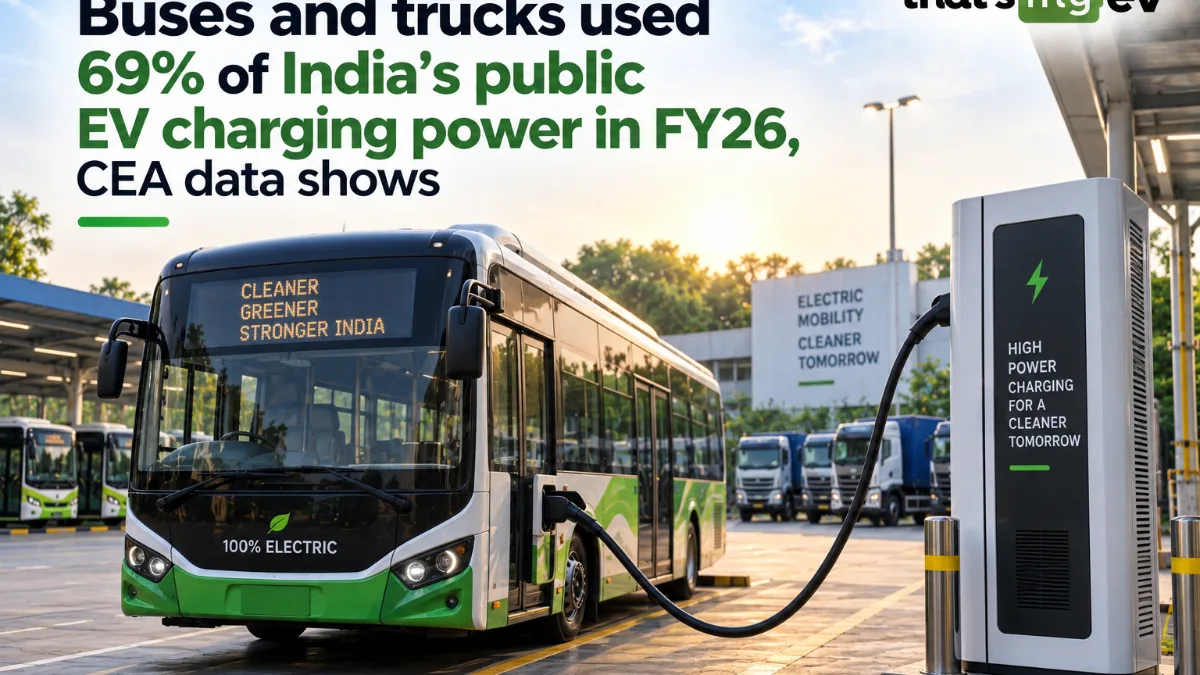
Buses and trucks used 69% of India's public EV charging power in FY26, CEA data shows
India's EV charging stations drew 1,558.69 million units of electricity in FY26, and the Central Electricity Authority's report for the year shows 69% of it went to heavy-duty sites used mainly by buses and trucks. The total is growing fast, but the part that describes where cars charge is far smaller than the headline.
That matters for anyone deciding whether public charging can replace a charger at home. The figure that describes the chargers cars actually use is less than a quarter of the headline, and it is spread very unevenly across states. It sits alongside the three competing official counts of public chargers as the other half of the infrastructure picture.
What the CEA Report Shows
The CEA's March 2026 monthly report, published on 10 August 2026, gives the full FY26 picture from April 2025 to March 2026. Charging stations drew 1,558.69 million units (MU) of electricity in the year; one MU is one million kWh. The CEA splits that into three categories, and the split is the story.
Category (CEA) | FY26 electricity (MU) | Share |
Heavy-duty public charging stations | 1,081.87 | 69% |
Public charging stations, excluding heavy-duty | 378.09 | 24% |
Charging stations other than public | 98.74 | 6% |
Total | 1,558.69 | 100% |
Figures from the Central Electricity Authority, EV Public Charging Stations Monthly Power Consumption Report, March 2026, accessed 22 September 2026. Shares are our calculation, rounded.
Monthly use rose from 107.41 MU in April 2025 to 149.59 MU in March 2026, a rise of about 39% over the year on the CEA's figures. March's 149.59 MU is about 15% above the FY26 monthly average of roughly 130 MU, so FY27 opens from a higher base (our calculation).
What 'heavy-duty' does and does not tell you The CEA classifies charging stations, not vehicles. Its heavy-duty category covers high-power public sites used mainly by buses and trucks. The other public category mixes cars, two-wheelers and three-wheelers, so ThatsMyEV does not treat 378.09 MU as a car-only figure. The report also depends on discoms' filing data: Himachal Pradesh, Uttarakhand, Jharkhand, Chandigarh, Puducherry and most north-eastern states reported nothing for FY26. |
Which States Use the Most
The CEA ranks Delhi first on total use at 435.31 MU, 27.9% of the national figure, followed by Maharashtra, Karnataka and Telangana. On the non-heavy-duty measure, the order changes.
State | Total FY26 (MU) | Heavy-duty share | Non-heavy-duty public (MU) |
Delhi | 435.31 | 68% | 64.67 |
Maharashtra | 386.62 | 79% | 73.84 |
Karnataka | 214.70 | 82% | 36.69 |
Telangana | 111.26 | 86% | 16.00 |
Gujarat | 89.55 | 91% | 7.29 |
Uttar Pradesh | 79.86 | 27% | 53.96 |
Figures from the CEA March 2026 report, state-wise table, April 2025 to March 2026. Heavy-duty shares are our calculation.
Maharashtra leads the non-heavy-duty pool at 73.84 MU, ahead of Delhi at 64.67 MU and Uttar Pradesh at 53.96 MU. Gujarat's public charging is 91% heavy-duty on the CEA figures, the highest share among the large states. Readiness rankings such as NITI Aayog's electric mobility index measure infrastructure; the CEA series is the only official measure of use.
Delhi's 68% heavy-duty share points to fleet charging rather than private cars. For a private buyer there, the road-tax relief in the Delhi EV Policy 2026 does more to the cost of ownership than public charging volume does.
Can't charge at home and not sure public charging will work for you? Get a free expert callback |
JSW's Ampstar Launch Adds to the Heavy-Duty Load
JSW Greentech launched Ampstar, its electric truck and bus brand, in Mumbai on 22 September 2026. JSW's press release describes a 90-acre plant at AURIC in Chhatrapati Sambhajinagar and power configurations from 150kW to 500kW, with charging, financing and battery-as-a-service offered alongside the vehicles.
JSW Group executives put first-phase capacity at 15,000 vehicles a year, 10,000 buses and 5,000 trucks, and the investment at ₹2,500 crore. The first trucks are 55-tonne tractor-trailers for closed-loop industrial routes, which charge at fixed points. Every vehicle of that kind adds to the heavy-duty column, not the one car owners use.
What This Means for Charging Plans
The growth in public charging electricity is real, but it is mostly buses and trucks. The part that reflects cars is smaller and concentrated in Maharashtra, Delhi and Uttar Pradesh. Money is still going into chargers: our reporting on PM E-DRIVE charger sanctions covers why sanctioned sites and working sites are different numbers.
If you are planning where to charge, start from our EV charging guide, then look at your own state's non-heavy-duty figure rather than the national headline.
The ThatsMyEV Take
The rising FY26 total will be read as proof that India's EV charging network has arrived. On the CEA's own categories, what has arrived is a bus-and-truck charging network, built at depots and fleet sites, with public charging for everyone else growing much more slowly underneath it.
What decides whether that changes is data as much as hardware. Until discoms report car-grade DC fast charging separately from two-wheeler and three-wheeler use, nobody can say how much of the 378.09 MU is cars. That is the number a car buyer needs, and it does not exist in any official series.
Our advice, dated 22 September 2026: a buyer looking at a Tata Nexon EV in Jaipur or Chennai with no home or workplace charger should not buy on the strength of national charging headlines. Rajasthan's non-heavy-duty public use was 15.03 MU in FY26 and Tamil Nadu's 13.93 MU, a fifth of Maharashtra's. Sort out a charger where the car sleeps first; in those states, treat public charging as the backup.
Frequently Asked Questions
How much electricity do India's public EV chargers use?
India's EV charging stations drew 1,558.69 million units of electricity in FY26, April 2025 to March 2026, according to the Central Electricity Authority. Of that, 1,081.87 MU went to heavy-duty public chargers used mainly by buses and trucks, and 378.09 MU to other public chargers.
What share of EV charging electricity goes to buses and trucks?
About 69%. The CEA's FY26 report puts heavy-duty public charging stations at 1,081.87 MU out of a national total of 1,558.69 MU. The CEA classifies stations rather than vehicles, but its heavy-duty category covers the high-power sites used mainly by electric buses and trucks.
Which state uses the most electricity at EV chargers?
Delhi, with 435.31 MU in FY26, or 27.9% of the national total, according to the CEA. About 68% of Delhi's figure was heavy-duty charging. On non-heavy-duty public charging, Maharashtra leads at 73.84 MU, ahead of Delhi at 64.67 MU and Uttar Pradesh at 53.96 MU.
How much EV charging electricity do cars use in India?
No official figure separates cars. The CEA's non-heavy-duty public category, 378.09 MU in FY26, includes cars, two-wheelers and three-wheelers together. Until discoms report car-grade fast charging separately, the share used by electric cars cannot be stated from government data.
What is a million units of electricity?
One million units, written MU, is one million kilowatt-hours, the same unit an electricity bill uses. India's EV charging stations drew 1,558.69 MU in FY26 according to the CEA. That is a small fraction of national electricity demand, but it is growing month on month.
What is JSW Ampstar?
Ampstar is JSW Greentech's electric truck and bus brand, launched in Mumbai on 22 September 2026. JSW says vehicles will be built at a 90-acre plant in Chhatrapati Sambhajinagar, and group executives put first-phase capacity at 15,000 vehicles a year and investment at ₹2,500 crore.
Which states did not report EV charging data to the CEA?
Himachal Pradesh, Uttarakhand, Jharkhand, Chandigarh, Puducherry, Sikkim and most north-eastern states except Assam reported no EV charging consumption in the CEA's FY26 report. Their discoms had not filed data, so the national total of 1,558.69 MU understates actual use.
Is public EV charging growing in India?
Yes. The CEA's figures show monthly consumption at charging stations rising from 107.41 MU in April 2025 to 149.59 MU in March 2026, about 39% within the year. Most of that volume is heavy-duty charging for buses and trucks rather than cars.
Want a charging plan for your city before you buy? Ask a TMEV expert on WhatsApp |
Sources
Central Electricity Authority, Electric Vehicles Public Charging Stations Monthly Power Consumption Report, March 2026, covering April 2025 to March 2026, published 10 August 2026 and accessed 22 September 2026 at cea.nic.in; JSW Group press release on the Ampstar launch, 22 September 2026, jsw.in, with capacity and investment figures from JSW Group executives at the launch. All percentage shares are our calculations based on CEA figures.
Comments
Write your comment on Buses and trucks used 69% of India's public EV charging power in FY26, CEA data shows
No comments yet. Be the first to share your thoughts.