PM E-DRIVE Charging Money: 72,000 Stations Promised, 18,811 Points Costed
Quick Summary
India had 52,718 public charging stations in July 2026, against 5,151 in 2022 (Ministry of Heavy Industries figure, cited in the IEEFA note)
The PM E-DRIVE public charging allocation is ₹2,000 crore inside a ₹10,900 crore scheme
IEEFA costs that allocation at about 18,811 charging points, under 2 per cent of the 1.32 million it estimates India needs by 2030 (IEEFA estimate)
The heavy industries ministry has said the same ₹2,000 crore supports about 72,000 public charging stations (ministry statement)
Grid connection work can account for up to half the cost of a public charging site (IEEFA estimate)
An earlier IEEFA field study found about 84 per cent of the Delhi chargers it examined were out of service (independent survey, 2024)
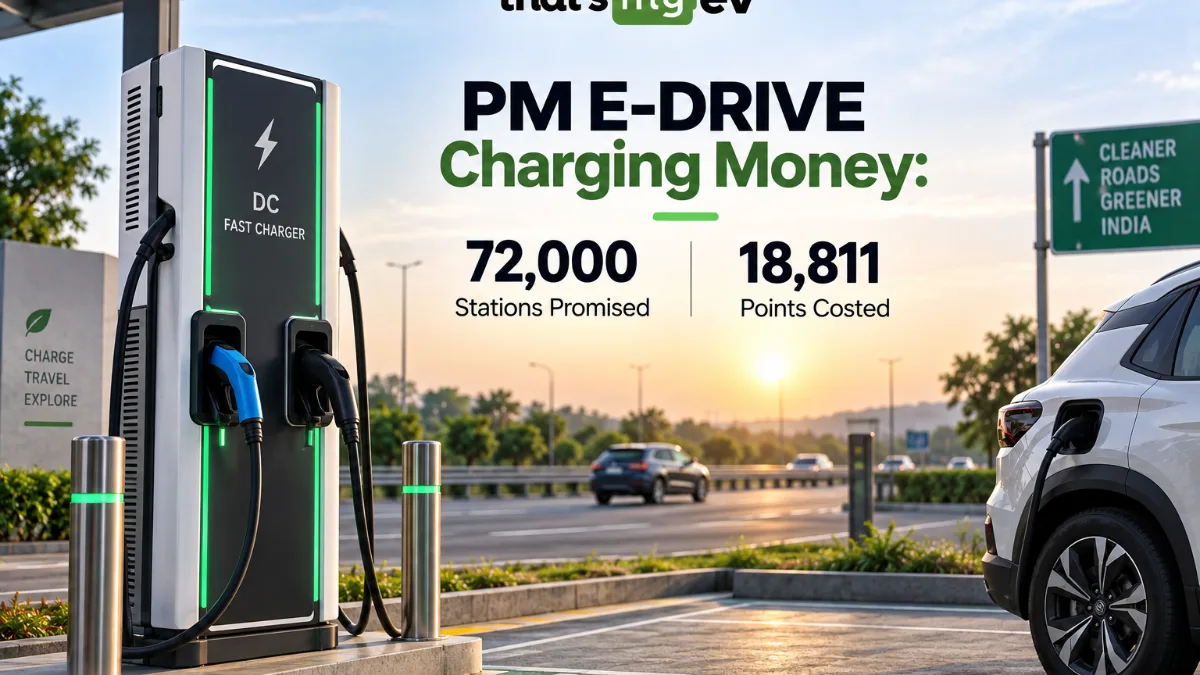
PM E-DRIVE Charging Money: 72,000 Stations Promised, 18,811 Points Costed
The Ministry of Heavy Industries has said the ₹2,000 crore set aside for public charging under PM E-DRIVE will support roughly 72,000 charging stations. A briefing note published on 16 September 2026 by the Institute for Energy Economics and Financial Analysis puts the same money at about 18,811 charging points. Both figures come from documents you can read. They are not close to each other.
That gap matters to anyone weighing an EV purchase, because the public network is the part of ownership a buyer cannot arrange for themselves. We have written about the sanctioned-but-uninstalled charger problem and about the three official charger counts that do not agree. This is a different question: whether the money set aside is the right size for the job.
The two numbers, and where each comes from
IEEFA arrives at 18,811 by costing the policy target mix of charger types and assuming a full subsidy for both the charger equipment and the upstream electrical work. Its note, written by Charith Konda and Dhruv Garg, sets that against 1.32 million public chargers it estimates India needs to support the government’s stated goal of 30 per cent EV adoption by 2030. On those assumptions, the allocation covers under 2 per cent of the requirement.
The ministry’s own 72,000 figure describes charging stations deployed along 50 national highway corridors and at metros, toll plazas, railway stations, airports and fuel outlets. A station and a charging point are different units, and a station that carries several guns counts once. Part of the gap is therefore definitional rather than a dispute about arithmetic. We estimate that unit differences explain some of it but not a factor of four, and neither document publishes the per-charger cost that would settle it.
India’s public charging network: key numbers
Figure | Value | Where it comes from |
Public charging stations, July 2026 | 52,718 | Ministry figure |
Public charging stations, 2022 | 5,151 | Ministry figure |
PM E-DRIVE public charging allocation | ₹2,000 crore | Scheme documents |
PM E-DRIVE total outlay | ₹10,900 crore | Scheme documents |
Charging points that allocation covers | about 18,811 | IEEFA estimate |
Charging stations the ministry says it covers | about 72,000 | Ministry statement |
Public chargers needed by 2030 | about 1.32 million | IEEFA estimate |
EV sales, FY2025-26 | about 2.5 million | Cited in the IEEFA note |
Electric car share of sales, July 2026 | 7.9 per cent | Cited in the IEEFA note |
Station counts, the scheme outlay and the 72,000 figure are from Ministry of Heavy Industries and PIB material, accessed 16 September 2026. Rows marked IEEFA estimate are from its briefing note of the same date.
Two primary sources, one unresolved gap A charging station and a charging point are not the same unit, and the two estimates assume different subsidy shares. We are publishing both numbers rather than picking the one that makes a better headline. What would settle it: a published per-charger sanction cost from the ministry, or a station-to-point ratio for sanctioned projects. |
Why the gap exists: grid work is the hidden cost
The IEEFA note puts a number on something charge point operators have been saying for years. Upstream grid upgrades, meaning the transformer and cabling work needed to bring enough power to a site, can account for as much as half the total cost of building a public charging station. That cost sits with the operator, who is also dealing with low utilisation at most sites.
The note’s recommendation is to finance grid upgrades separately, through infrastructure or development finance, rather than expecting a charging business to carry them. That is a structural argument rather than a subsidy-size argument, and it is the more interesting half of the document. On our reading, the operator economics, and the tariff and Goods and Services Tax treatment of public charging, decide how many of the sanctioned chargers get built and stay working.
Reliability is the part buyers actually feel
Counting chargers measures ambition. Working chargers measure the experience. An earlier IEEFA field study, published in 2024, found that about 84 per cent of the chargers it examined across representative parts of Delhi were not functional at the time of the survey. The new note repeats that users continue to report dead chargers, including at fuel stations and other public sites, and identifies interoperability between networks and payment friction as separate problems.
It also flags home charging, which is where most EV charging happens everywhere else in the world. Housing societies delaying or refusing charger installation is listed as a barrier, and the note argues that home charging should not be left to the discretion of individual resident associations. This is the single most common question on our expert line from buyers in Delhi-NCR apartments, and it has nothing to do with how many highway chargers exist.
If you want the practical version of all this, our EV charging guide for Indian buyers covers home wall boxes, society permissions and what a realistic DC session costs.
Charging at an apartment building is the question we get most. Ask a ThatsMyEV expert on WhatsApp |
What We Still Don’t Know
The per-charger sanction cost the ministry is working to. Without it, the 72,000 figure cannot be checked against the 18,811 estimate.
How many of the sanctioned PM E-DRIVE chargers are energised and operating, as distinct from approved or installed?
Whether the Goods and Services Tax treatment of public charging changes, which IEEFA identifies as a cost problem. No notification has been issued.
The current nationwide uptime rate. The 84 per cent failure figure is a 2024 Delhi sample, not a 2026 national number, and nobody publishes a national uptime series.
What this means if you are buying an EV in the next year
Nothing in this note changes which car to buy. It changes how much weight to put on a home charging plan. A buyer with a dedicated parking slot and society permission is insulated from most of what the note describes. A buyer relying on public charging for weekday top-ups is exposed to uptime, pricing, and interoperability, none of which a brochure will tell you about.
Range matters here too, and not in the way brochures suggest. A car with a genuinely large certified range reduces how often you touch the public network. You can sort every EV on sale in India by certified range, or browse the full list of electric cars on sale if you are at the shortlist stage. If the cycle labels confuse you, our explainer on MIDC, WLTP and CLTC is the short version.
The ThatsMyEV Take
What the government is doing with PM E-DRIVE is buying visible assets. Chargers at toll plazas and fuel outlets are countable, photographable and easy to announce. What IEEFA is pointing at is the unglamorous half: grid connections, uptime obligations, tariff design and the tax treatment of a kilowatt-hour sold at a public charger. The first half wins press releases. The second half decides whether the first half works.
The thing that will decide this is not the size of the fund. It is whether a charge point operator can make money at a site that sits idle for most of the day. If grid upgrade costs stay on the operator’s balance sheet, the sanctioned chargers will keep arriving slowly and dying quietly, and the 2030 number stops being a target and becomes a talking point.
What we would tell a buyer in September 2026: do not let charger counts drive your purchase decision either way. Sort out home charging first, in writing, with your society, before you book. If that is not possible, buy the longest certified range you can afford and treat public charging as a backup rather than a plan. We would not pay a premium for a car on the strength of a charging network that has not been independently measured for uptime since 2024.
Frequently Asked Questions
How many public EV charging stations does India have in 2026?
India had 52,718 public EV charging stations as of July 2026, a figure from the Ministry of Heavy Industries. That compares with 5,151 in 2022, so the network has grown more than tenfold in four years. The count measures stations rather than individual charging points, and it does not indicate how many of those stations are working at any given time.
How much has the government budgeted for EV charging under PM E-DRIVE?
PM E-DRIVE sets aside ₹2,000 crore for public EV charging within a total scheme outlay of ₹10,900 crore. The scheme was notified in September 2024 and its duration has been extended to 31 March 2028. The charging allocation covers fast chargers along national highway corridors and at metro locations, toll plazas, railway stations, airports and fuel outlets.
Is ₹2,000 crore enough to build the EV chargers India needs?
IEEFA’s briefing note of 16 September 2026 estimates the allocation covers about 18,811 charging points, under 2 per cent of the 1.32 million public chargers it estimates India needs by 2030. The Ministry of Heavy Industries has separately said the same allocation supports about 72,000 charging stations. The two figures use different units and different assumptions, and neither side has published the per-charger cost that would reconcile them.
Why are so many public EV chargers in India out of service?
An IEEFA field study published in 2024 found about 84 per cent of the chargers it examined across representative areas of Delhi were not functional during the survey. Its 2026 note identifies the causes as weak uptime obligations, thin operator margins at low-utilisation sites and slow grid connection work. No national uptime series is published, so the true current figure is unknown.
What is the biggest cost in setting up a public EV charging station?
IEEFA estimates that upstream grid work, meaning the transformer and cabling needed to bring adequate power to the site, can account for up to 50 per cent of the total cost of a public charging station. Its recommendation is that this cost be financed separately through infrastructure or development finance rather than carried by the charge point operator.
Does the IEEFA report say India should stop building chargers?
No. The note argues that charger numbers alone will not lift EV adoption and that reliability, affordability and home charging access need equal attention. It groups its recommendations under three headings: convenience, cost and ecosystem enablers, covering uptime, interoperability, payment, tax treatment, grid readiness and time-of-use tariffs.
How fast are EV sales growing in India in 2026?
Annual EV sales across all vehicle categories rose from about 50,000 in 2016 to roughly 2.5 million in FY2025-26, figures cited in the IEEFA note. Monthly sales in July 2026 were 307,752 units, up 63.2 per cent year on year. Electric cars accounted for 7.9 per cent of car sales that month, so adoption remains well below the government’s 30 per cent target for 2030.
Can my housing society refuse to let me install an EV charger?
IEEFA’s note identifies housing societies delaying or refusing charger installation as a genuine barrier to EV adoption in India, and recommends that home charging access stop being left to the discretion of individual resident associations. Rules vary by state EV policy and by state building norms, so the answer depends on where you live and what your society bye-laws say.
Should I buy an EV in India if public charging is unreliable?
If you can charge at home overnight, public charger reliability affects only long highway trips and is a manageable risk. If you have no home or office charging, it becomes a daily problem rather than an occasional one. Our advice is to secure a home charging arrangement in writing before booking, and to treat public charging as a backup rather than a primary plan.
How long does PM E-DRIVE run and what does it cover?
PM E-DRIVE was notified on 29 September 2024 with a ₹10,900 crore outlay and has been extended to 31 March 2028. It covers demand incentives for electric two-wheelers, three-wheelers, ambulances, buses and trucks, along with the ₹2,000 crore public charging allocation. Electric cars do not receive a purchase subsidy under the scheme.
Working out whether an EV fits your parking and commute? Get a free expert callback |
Sources
IEEFA briefing note, "Improving the EV charging experience in India: Beyond charger deployment", by Charith Konda and Dhruv Garg, published 16 September 2026 and accessed the same day. Ministry of Heavy Industries statements on the PM E-DRIVE public charging allocation and the 72,000-station deployment plan, and the PIB release carrying the 52,718 figure for July 2026, accessed 16 September 2026. The 2024 IEEFA Delhi charger survey is cited within the 2026 note.
Comments
Write your comment on PM E-DRIVE Charging Money: 72,000 Stations Promised, 18,811 Points Costed
No comments yet. Be the first to share your thoughts.