Can Your Housing Society Refuse an EV Charger? What the Ministry of Power's 2024 Rules Say
Quick Summary
Ministry of Power order No. 12/2/2018-EV of 17 September 2024 lets residents fit a private charger in their own designated parking.
Power comes through the resident's existing meter or a separate sub-meter, with the DISCOM responsible for supply.
Separate EV connections are due in 3 days in metros, up to 90 days where network work is needed (Electricity (Rights of Consumers) Rules, 2020).
RWAs may set up community charging points in consultation with the DISCOM.
The guidelines bind utilities, not society bye-laws; a Supreme Court petition seeking enforcement has been pending since notice on 24 February 2026.
With allotted parking, submit a written request citing the order; without it, shortlist for public charging.
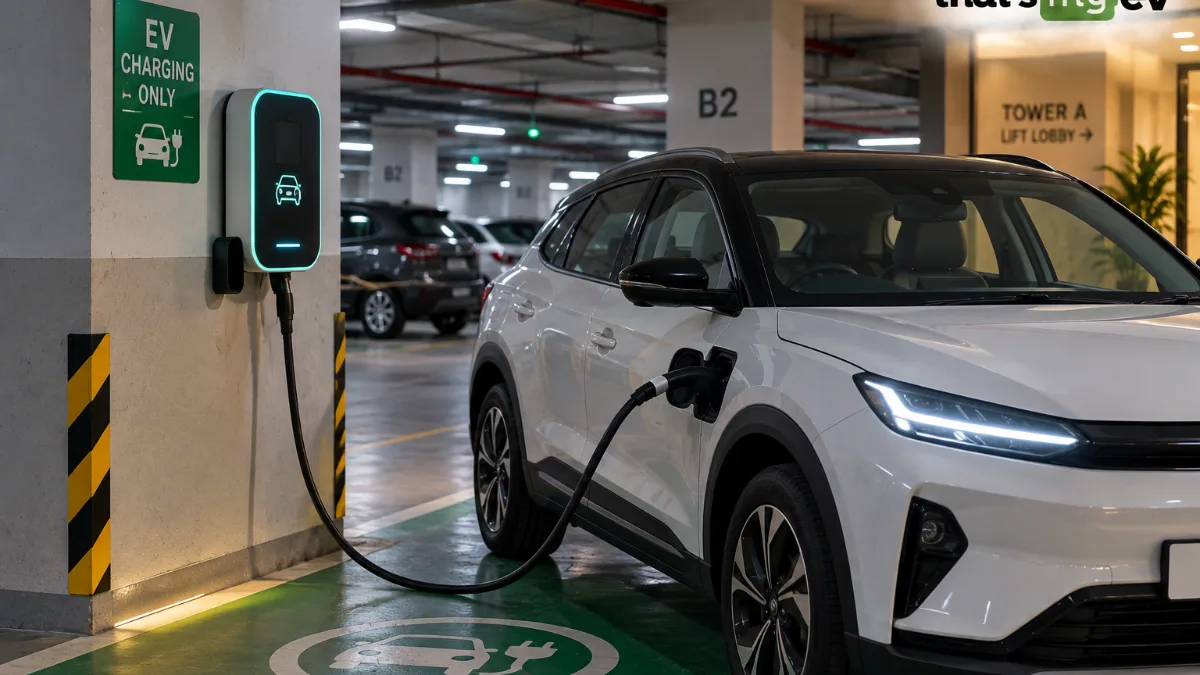
Can Your Housing Society Refuse an EV Charger? What the Ministry of Power's 2024 Rules Say
If you are about to buy an electric car and your housing society hasn't approved a home charger, the document to put on the table is the Ministry of Power's Order No. 12/2/2018-EV, dated 17 September 2024. It sets out the Guidelines for Installation and Operation of Electric Vehicle Charging Infrastructure-2024, which allow a resident to install a private charger in their designated parking space and place the responsibility for supplying power on the electricity distribution company.
That matters because home charging is what makes an EV cheap to run. A car you can only charge in public costs more per kilometre and takes more planning, which is why the question of society permission belongs in the buying decision, not after it. Our EV charging guides cover the public side.
What the 2024 Guidelines Say About Residents
The 2024 guidelines supersede every earlier version the ministry issued, including the January 2022 revision, which PIB described at the time as letting owners charge at their residence or office using their existing electricity connection. The 2024 text keeps that principle and spells out how it applies inside a housing society.
For a private charger, the guidelines say a resident can install one in their designated parking space, and the distribution licensee will supply power either through the resident's existing meter or a separate sub-meter. A resident, a flat owner or the RWA can also ask the DISCOM for a separate metered connection on a dedicated EV charging tariff, to be provided within the timelines of the Electricity (Rights of Consumers) Rules, 2020.
Housing Society EV Charging: Key Provisions
Situation | What the 2024 guidelines provide |
Charger in your own allotted parking | Permitted; power through your existing meter or a separate sub-meter |
Separate EV connection | Resident, flat owner or RWA may apply for a metered connection on an EV tariff |
Connection timelines | 3 days in metro areas, 7 in other municipal areas, 15 in rural areas, 30 in hilly rural areas, 90 where network work is needed |
Society-wide charging | RWA may set up community charging points in consultation with the DISCOM |
Visitor charging | Community points may be opened to authorised visitors |
Charger standard | Chargers must meet the Indian Standards listed in the guidelines |
Provisions from Ministry of Power order No. 12/2/2018-EV of 17 September 2024. Connection timelines as set under the Electricity (Rights of Consumers) Rules, 2020, as amended.
Guidelines are not a court order The 2024 guidelines bind public agencies and power utilities. They do not rewrite a cooperative society's own bye-laws, and no national law yet gives a resident a statutory right to charge. That is why disputes with societies have gone to the courts, and why a written, reasoned request works better than quoting the guidelines alone. |
What a Society Can Fairly Ask For
A society is on firm ground asking how the charger will be installed, not whether you may have one. Reasonable questions cover the cable route from your meter to your parking bay, the load the building's supply can carry, compliance with electrical safety norms and fire rules for the parking area, and who pays for installation and electricity. Every one of those has a written answer an electrician can give.
It helps to know what you are asking for. Most home installations are a 3.3kW or 7.2kW AC wallbox rather than a DC fast charger, and our guide to home charging explains the difference. Pick the car's onboard charger rating first, then size the wallbox to match, so the request you submit is specific.
If Your Society Says No
Put the request in writing, with the charger specification, the Indian Standard it meets, your electrician's load assessment and whether you want it on your existing meter or a separate EV connection. Cite the Ministry of Power order by number and date, and ask for any refusal and its reasons in writing too. A written refusal with no safety ground is far harder for a society to defend.
If that fails, the DISCOM is the next stop, because the guidelines give it the supply role, followed by your state's designated nodal agency for EV charging. The Bombay High Court heard a resident's petition over a refused charger permission on 14 January 2025, and a Greater Noida resident's petition asking for the 2024 guidelines to be enforced is before the Supreme Court, which issued notice on 24 February 2026. The Supreme Court has not ruled on it as of 23 September 2026.
Stuck on society permission before you book? Get a free expert callback |
The ThatsMyEV Take
What the Ministry of Power has done is give residents the right to charge on paper, twice, in 2022 and again in 2024, and leave enforcement to DISCOMs, states and courts. The principle is settled at the national level. What is not settled is whether a society committee can still stall a resident indefinitely by withholding a no-objection letter.
What decides this is the Supreme Court petition. A ruling that the 2024 guidelines bind housing societies would turn a request into an entitlement across the country. Until then, the practical outcome depends on how organised the resident is and how willing the DISCOM is to act on its supply role.
ThatsMyEV's advice to a buyer on 23 September 2026: if you have allotted parking, do not let a society's hesitation stop the purchase. Book the car, put the written request in the same week, and use the order number. If your parking is unallotted or shared, the guidelines help far less, so shortlist an EV you could live with on public charging, check the chargers on your two most-used routes, and use our comparison tool to weight certified range. Browse every electric car on sale with that constraint in mind.
Frequently Asked Questions
Can a housing society stop me installing an EV charger in India?
Under the Ministry of Power's 2024 EV charging guidelines, a resident may install a private charger in their own designated parking, with power through their existing meter or a sub-meter. A society can reasonably ask about safety, load, and cost, but the guidelines do not give it a blanket right to refuse.
Which government rule allows EV chargers in housing societies?
The Guidelines for Installation and Operation of Electric Vehicle Charging Infrastructure-2024, issued by the Ministry of Power as Order No. 12/2/2018-EV on 17 September 2024. They supersede all earlier Ministry of Power charging guidelines, including the January 2022 revision.
Do I need a separate electricity meter for a home EV charger?
No, the 2024 guidelines allow a private charger to run through your existing meter or a separate sub-meter. You can also apply to your DISCOM for a separate metered connection on a dedicated EV charging tariff if your state offers one.
How long does a DISCOM take to give an EV charging connection?
The 2024 guidelines tie EV connections to the Electricity (Rights of Consumers) Rules, 2020: 3 days in metro areas, 7 days in other municipal areas, 15 days in rural areas, and 30 days in hilly rural areas, or 90 days where network work is needed.
Can an RWA install shared EV chargers in a society?
Yes, the 2024 guidelines let an RWA set up community charging points within its premises in consultation with the DISCOM. Residents decide the number and type of chargers, and the points can be opened to authorised visitors.
What can a housing society ask for before allowing an EV charger?
A society can reasonably ask for the cable route, a load assessment, compliance with electrical safety and fire norms, the charger's Indian Standard certification, and who pays for installation and power. These are questions about how, not whether, the charger is installed.
What should I do if my society refuses an EV charger?
Submit a written request with the charger specification, a load assessment, and the Ministry of Power order number, and ask for any refusal in writing. If it is still refused, approach your DISCOM and your state's nodal agency for EV charging.
Is there a Supreme Court case on EV chargers in housing societies?
Yes, a Greater Noida resident's petition asks the Supreme Court to direct enforcement of the 2024 guidelines. The court issued notice to the Union government and Uttar Pradesh on 24 February 2026, and had not ruled on it as of 23 September 2026.
What charger size do I need at home for an electric car?
Most homes use a 3.3kW or 7.2kW AC wallbox. The right size depends on your car's onboard AC charger rating and your building's available load, so check both before applying to your society.
Want a second opinion on charging before you buy? Ask a TMEV expert on WhatsApp |
Sources
Ministry of Power order No. 12/2/2018-EV, Guidelines for Installation and Operation of Electric Vehicle Charging Infrastructure-2024, 17 September 2024, as cited in the Ministry of Heavy Industries PM E-DRIVE charging station guidelines; the ministry's own copy was not loading on 23 September 2026. PIB release on the January 2022 revision. Residential provisions checked against a February 2025 dispute-resolution note by Cyril Amarchand Mangaldas. Court details from Supreme Court and Bombay High Court proceedings as publicly recorded.
Comments
Write your comment on Can Your Housing Society Refuse an EV Charger? What the Ministry of Power's 2024 Rules Say
No comments yet. Be the first to share your thoughts.