Delhi tops NITI Aayog's Electric Mobility Index 2025, but Karnataka runs the charging network
Quick Summary
NITI Aayog scored Delhi 84 out of 100 in the India Electric Mobility Index 2025, released 16 September 2026
Maharashtra took second on 78 and Karnataka third on 73.
Karnataka scored 97 for charging infrastructure readiness, the strongest theme score in the index.
Delhi scored 94 for EV research and innovation, the highest on that theme.
The national median score rose from 36 to 40 across 36 states and union territories.
The index scores data from January to December 2025, so 2026 policy changes are outside the window.
Readiness is not the same as a working charger on your route, and the index does not score utilisation.
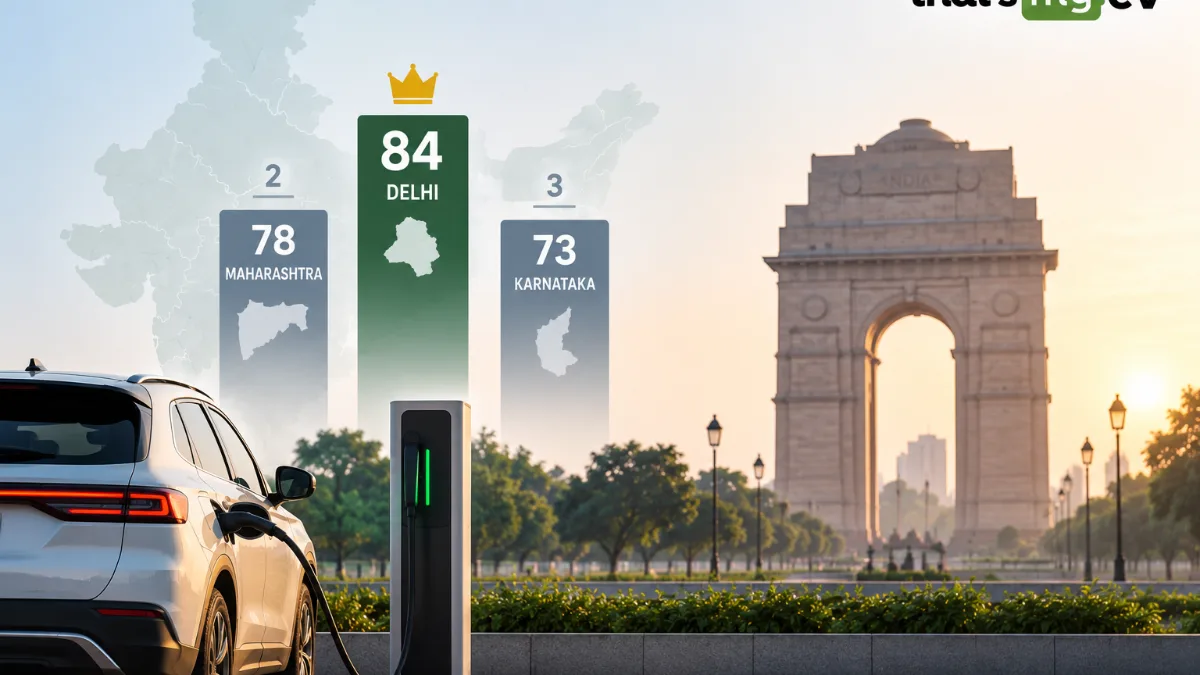
Delhi tops NITI Aayog's Electric Mobility Index 2025, but Karnataka runs the charging network
NITI Aayog scored Delhi 84 out of 100 in the second India Electric Mobility Index, released on 16 September 2026. That is the highest figure recorded in either edition of the index. The score a car buyer should read sits two rows below it: Karnataka, third overall on 73, took 97 for charging infrastructure readiness, the strongest single theme score anywhere in the table.
WRI India prepared the index in collaboration with NITI Aayog, and it covers 36 states and union territories across 16 indicators. It measures readiness rather than sales, so it is not a league table of where electric cars are selling.
What NITI Aayog has confirmed
The 16 indicators sit under three themes, weighted. Transport electrification progress carries half the total score, charging infrastructure readiness 30 percent and EV research and innovation status the remaining 20 percent, according to the published methodology. The assessment period runs from January to December 2025.
Performance improved against the first edition on both measures, NITI Aayog reports. The top score rose from 77 to 84, and the national median rose from 36 to 40. The index also records that 29 of the 36 states and union territories assessed have notified an EV policy.
Rank | State or union territory | IEMI 2025 score |
1 | Delhi | 84 |
2 | Maharashtra | 78 |
3 | Karnataka | 73 |
4 | Chandigarh | 71 |
5 | Goa | 65 |
Category leader | Manipur, hilly and northeastern states | 46 |
National median | All 36 states and union territories | 40 |
Scores from the India Electric Mobility Index 2025, NITI Aayog and WRI India, accessed 20 September 2026. In the 2024 edition Delhi scored 77, Maharashtra 68 and Karnataka 64.
Why Karnataka's 97 matters more than Delhi's 84
Delhi's lead is built on adoption and research. Its 94 for EV research and innovation is the highest score any state recorded on that theme, and it reflects startups, patents and institutional capacity rather than anything a buyer touches. Karnataka's 97 for charging infrastructure readiness is a different kind of number. That theme scores charger-to-vehicle ratio, subsidies for charging infrastructure, building bye-laws for charging and power availability, which together describe whether you can plug in, not whether your neighbours already drive an EV. We covered the gap between sanctioned and installed chargers in our piece on India's three official public charger counts.
Building bye-laws are the indicator worth pausing on. Across the consultations we run on the ThatsMyEV expert line, the question that comes up most on any electric car above ₹20 lakh is charging at an apartment building, and that is precisely the permission problem the bye-law indicator measures. A state that has fixed it has removed the single biggest obstacle to ownership for a flat-dwelling buyer. Our EV charging guides cover what to ask your society before you book.
A readiness score is not a car ownership score Transport electrification progress carries 50 percent of the weighting and counts two-wheelers, three-wheelers, buses and cars together. A state can climb the table on scooter volume without a single new car charger. If you are buying an electric car, read the charging theme, not the headline rank. |
What the index measures, and when
The data window closes at December 2025. Delhi's EV Policy 2026 and every charger commissioned this year sit outside these scores, so the table describes where states stood at the end of last year rather than where they stand now. NITI Aayog scores readiness rather than utilisation, which means a high charging score confirms that chargers and the rules around them exist, not that they are working when you arrive.
Should you factor this into a purchase?
If you are buying in Delhi, the index and the state policy point the same way, and our Delhi EV Policy 2026 buyer's guide sets out what you actually claim. In Karnataka, the 97 is the practical reason a longer-range car is less necessary than it looks, because topping up on the move is a realistic habit there rather than an occasional gamble.
Anywhere near the national median of 40, plan the opposite way. Budget for home charging from day one, treat public charging as a bonus, and weight range harder than you otherwise would when you compare two cars side by side. You can filter the full list on every electric car on sale in India to see which models clear the range you need.
Not sure how your state or your building affects the car you should buy? Get a free expert callback |
The ThatsMyEV Take
What NITI Aayog is really doing here is building a scoreboard for competitive federalism. The index exists to make state transport departments chase each other in public, and on the evidence of the median moving from 36 to 40 in one edition, it is working better than most government dashboards do.
The thing that will decide whether it keeps working is the weighting. Half the score rides on transport electrification, a theme two-wheeler volume dominates in India, so a state can improve its rank substantially without doing anything for car buyers. Charging readiness carries 30 percent. We would flip those weights, because chargers are the constraint and adoption is the outcome, and an index that rewards the outcome tells a state to celebrate rather than to build.
The advice for a buyer is specific. If you are shopping an electric car in Bengaluru or Delhi in September or October 2026, you can reasonably plan an ownership pattern that leans on public charging, and you can buy the smaller battery and save the money. Outside the top five states, do not. Buy the longer-range variant, fix home charging before delivery, and revisit the public network when the 2026 data lands next year.
Want a second opinion on the exact variant? Ask a ThatsMyEV expert on WhatsApp |
Frequently Asked Questions
Which state topped the India Electric Mobility Index 2025?
Delhi topped it with 84 out of 100. Maharashtra was second on 78, Karnataka third on 73, Chandigarh fourth on 71 and Goa fifth on 65. Delhi also led the 2024 edition, when it scored 77.
When did NITI Aayog release the India Electric Mobility Index 2025?
NITI Aayog released it on 16 September 2026, at a workshop on state EV policies. It is the second edition, following the 2024 index, and it was prepared by WRI India in collaboration with NITI Aayog.
What is the India Electric Mobility Index?
It is a composite score out of 100 that rates every Indian state and union territory on electric mobility readiness. It uses 16 indicators under three themes: transport electrification progress, charging infrastructure readiness, and EV research and innovation status.
Which state scored highest for EV charging infrastructure in the IEMI 2025?
Karnataka, with 97 for charging infrastructure readiness. That is the strongest theme score recorded in the index, and it covers charger-to-vehicle ratio, charging subsidies, building bye-laws for charging and power availability.
How is the India Electric Mobility Index scored?
Transport electrification progress carries 50 percent of the weighting, charging infrastructure readiness 30 percent and EV research and innovation status 20 percent. Scores run from 0 to 100 across 16 indicators, covering 36 states and union territories.
What was Karnataka's rank in the India Electric Mobility Index 2025?
Karnataka ranked third overall with 73, up from 64 in the 2024 edition. It led every state on charging infrastructure readiness with 97, which is the score that matters most to someone buying an electric car there.
What period does the India Electric Mobility Index 2025 cover?
The assessment period runs from January to December 2025. Policy changes and charger additions made during 2026 are outside the data window, so the scores describe where states stood at the end of 2025.
Does the India Electric Mobility Index rank electric car sales?
No. It measures readiness, not sales, and its transport electrification theme counts two-wheelers, three-wheelers and buses alongside cars. A state can rank highly on scooter volumes without strong electric car adoption.
How many Indian states have an EV policy?
The index records 29 of the 36 states and union territories assessed as having notified an EV policy. That leaves seven without one, which is the clearest gap the index exposes at a policy level.
Which state leads among hilly and northeastern states in the IEMI 2025?
Manipur, with 46. That is the highest score in the hilly and northeastern category, and it sits above the national median of 40 despite the terrain and grid constraints those states work under.
Did India's electric mobility scores improve in 2025?
Yes, on both measures, NITI Aayog reports. The top score rose from 77 to 84 and the national median rose from 36 to 40, which indicates improvement across the middle of the table rather than only at the top.
Sources
India Electric Mobility Index 2025, published by NITI Aayog with WRI India and hosted on niti.gov.in, accessed 20 September 2026; the 2024 first edition report on the same site, for the year-on-year comparison. Consultation patterns are from the ThatsMyEV expert line.
Comments
Write your comment on Delhi tops NITI Aayog's Electric Mobility Index 2025, but Karnataka runs the charging network
No comments yet. Be the first to share your thoughts.