India-EU FTA: Why Imported European EVs Get No Duty Cut Until Year 5
Quick Summary
Battery EVs and plug-in hybrids from the EU get no import duty concession in Years 1 to 4 of the India-EU FTA (Documented, India's tariff schedule).
From Year 5, a quota of 20,000 European EVs a year enters at 30% duty, falling to 10% by Year 10, against a listed base of 110%.
The EV quota rises to 50,000 cars in Year 10 and 90,000 from Year 14, and only covers cars with a landed (CIF) value of €20,000 or more.
European petrol and non-plug-in hybrid cars get a 1,00,000 car quota from Year 1, at 35% duty falling to 10% by Year 5 for cars valued €15,000 to €35,000.
India imported 17,191 cars from the EU in 2025, per the GTRI think tank's reading of trade data (Independent analysis).
The deal is not in force. The European Commission sent it to the EU Council for signature on 11 September 2026; India must still ratify it.
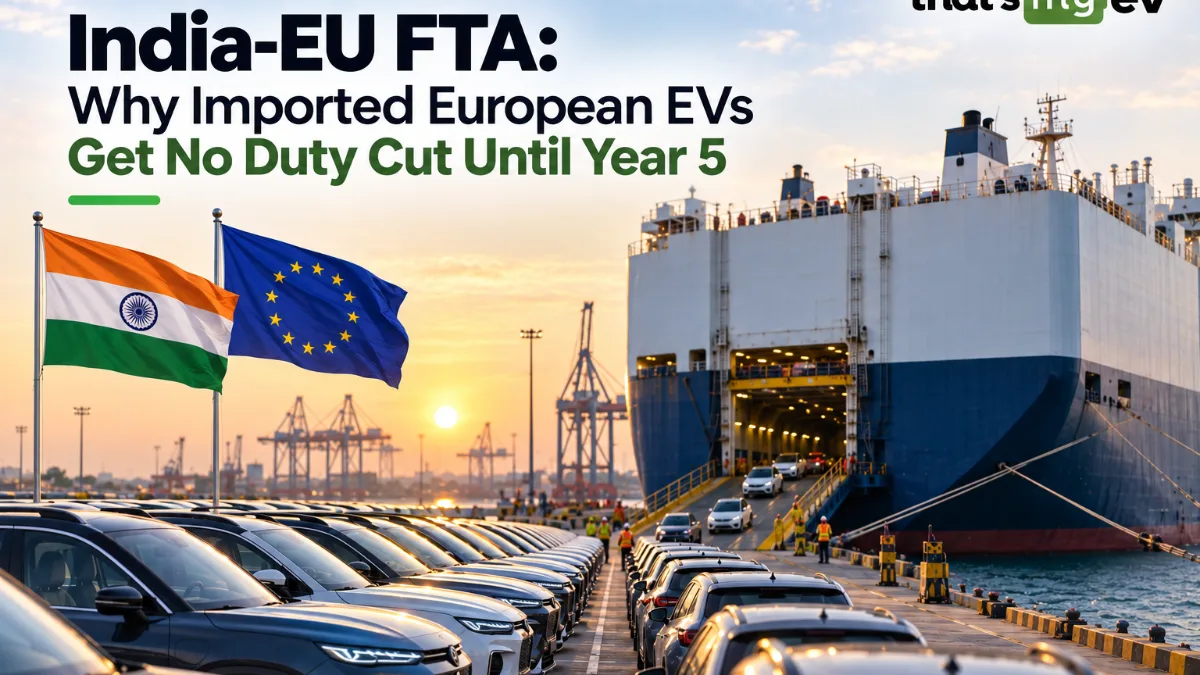
India-EU FTA: Why Imported European EVs Get No Duty Cut Until Year 5
The India-EU free trade agreement makes an imported European petrol hybrid cheaper four years before it does the same for a European electric car. India's tariff schedule, published by the European Commission as part of the draft agreement text, gives battery EVs and plug-in hybrids no duty concession at all in Years 1 to 4, then opens a quota of just 20,000 cars in Year 5.
That runs against the way the deal has been read in showrooms, where the headline is a cut from 110% to 10%. The cut is real for combustion and non-plug-in hybrid cars. For anyone shopping the luxury EVs on the ThatsMyEV price filter, the picture for the rest of this decade is close to unchanged.
What the tariff schedule sets for electric cars
The schedule groups battery-electric cars, plug-in hybrids and other new-technology passenger vehicles into one category, separate from petrol, diesel and self-charging hybrids. GTRI's reading of the schedule, which matches the Commission's published text, sets these terms for that category.
Term | European EVs and plug-in hybrids | European petrol and non-plug-in hybrids |
Concession starts | Year 5 | Year 1 |
Price floor (CIF value) | €20,000 and above | €15,000 and above |
First-year quota | 20,000 cars (Year 5) | 1,00,000 cars (Year 1) |
Quota in Year 10 | 50,000 cars | 1,60,000 cars |
Later quota | 90,000 cars from Year 14 | Stays at 1,60,000 |
In-quota duty | 30% in Year 5, falling 4 points a year to 10% in Year 10 | 35% in Year 1, 10% by Year 5 (cars valued €15,000 to €35,000) |
Listed base duty | 110% | 110% (€15,000 to €35,000 band) |
Figures from India's tariff schedule attached to Annex 2-A of the draft EU-India FTA text on the European Commission's trade website, cross-checked against GTRI's analysis of the schedule. Accessed 22 September 2026. All figures Documented: they are negotiated text, not yet in force.
The in-quota EV rate steps down four points a year, from 30% in Year 5 to 10% in Year 10, and stays there. EV-category cars valued below €20,000 get no concession in any year, which in practice excludes nothing Europe ships to India at present.
CIF value is not the showroom price The €15,000 and €20,000 thresholds are CIF values: the cost of the car plus insurance and freight at the Indian port, before any duty, GST or registration. At roughly ₹110 to the euro, our estimate puts €20,000 at about ₹22 lakh landed. A car with that CIF value reaches the showroom at several times the figure once duty and GST are added, so the floor says nothing about which ex-showroom price band will feel the change. |
Why the deal treats hybrids and EVs differently
Neither government has published a rationale, but the structure protects the segment where Indian makers have spent the most. Tata Motors and Mahindra built their EV ranges on domestic platforms, and four years without cheaper European EVs gives both time to scale. GTRI makes the same point about the mass market: combustion and hybrid cars valued below €15,000 are excluded altogether.
The scale of the combustion quota is the other half of the story. GTRI puts India's imports of EU-built cars at 17,191 units in 2025, against a first-year quota of 1,00,000. That is close to six times current volume, which means most European petrol and hybrid imports could come in at the lower rate from Year 1 onward.
When Year 1 actually starts
The negotiations closed on 27 January 2026. The European Commission sent its proposals for signing and concluding the agreement to the EU Council on 11 September 2026, according to the Commission's India trade page. After the Council authorises signature, the European Parliament must consent and the Council must take a final decision, and India has to ratify the agreement separately.
Neither side has published an entry-into-force date. If the agreement takes effect in 2027, which is our assumption for illustration and not a commitment by either government, the first EV quota would open in 2031. Every year of delay in ratification moves that date back by a year.
What it means for luxury EVs on sale in India
Almost every European EV sold here arrives fully built, and the schedule's EV quota is written for completely built units. Models assembled in India from kits are not what this quota covers, which is why local assembly remains the faster route to a lower price. BMW's decision to assemble the i5 long-wheelbase in India, logged in our EV news coverage, is the kind of move the schedule rewards more than any tariff line.
For buyers comparing a European EV against a locally built rival, the gap on the ThatsMyEV comparison tool is not going to close through trade policy before the next decade. Registration trends on our EV sales tracker will show whether European brands respond with more local assembly instead.
Weighing an imported EV against a local one? Get a free expert callback |
The ThatsMyEV Take
India has written a trade deal that opens the premium car market to Europe while keeping the EV market closed for four more years. That is deliberate. The combustion and hybrid quota is generous against current import volumes, and the EV quota is small, late, and priced high. The message to European makers is that India wants their EVs built here, not shipped here.
What decides whether that works is ratification speed and what European brands do in the meantime. If the deal enters force quickly, the first effect buyers will notice is cheaper imported hybrids, which could pull some luxury buyers away from EVs rather than towards them. That would be an odd outcome for a country trying to electrify its premium segment, and it is worth watching in the first year's registration data.
Our advice as of 22 September 2026: if you are waiting for a European EV to get cheaper because of this agreement, stop waiting. Nothing in the schedule reduces EV duty before Year 5. Buy on the prices and alternatives on sale as of that date, and check the top rated EVs in your budget before assuming an import is the only way to get the car you want.
Frequently Asked Questions
Will the India-EU FTA make European electric cars cheaper in India?
Not for the first four years. India's tariff schedule gives battery EVs and plug-in hybrids from the EU no concession until Year 5 of the agreement. From Year 5, a quota of 20,000 cars a year enters at 30% duty, falling to 10% by Year 10, for cars with a landed value of €20,000 or more.
When do EV import duty cuts start under the India-EU FTA?
EV duty cuts begin in Year 5 of the agreement. The deal is not yet in force: the European Commission sent it to the EU Council on 11 September 2026, and India must still ratify it. Neither side has published an entry-into-force date, so the calendar year of Year 5 is not yet known.
How many European EVs can enter India at lower duty under the FTA?
The quota starts at 20,000 cars in Year 5, rises to 50,000 in Year 10 and reaches 90,000 from Year 14, according to India's tariff schedule in the draft agreement. Imports beyond the quota pay the regular duty. The quota covers battery EVs, plug-in hybrids and other new-technology cars together.
Are plug-in hybrids treated as EVs in the India-EU FTA?
Yes. The schedule places plug-in hybrids in the same category as battery-electric cars, so they also wait until Year 5 for any concession. Self-charging hybrids without a plug sit with petrol and diesel cars instead, and get concessional duty from Year 1.
What import duty will European petrol and hybrid cars pay under the FTA?
For cars with a landed value of €15,000 to €35,000, the in-quota duty falls from a listed 110% to 35% in Year 1 and 10% by Year 5. The quota starts at 1,00,000 cars and rises to 1,60,000 by Year 10. Cars valued below €15,000 get no concession.
Does the India-EU FTA change the price of locally assembled EVs?
No. The EV quota in the schedule is written for completely built imports. Cars assembled in India from kits are taxed differently and are not what this quota covers, so the agreement does not directly change their price.
What does CIF value mean in the India-EU FTA car quota?
CIF stands for cost, insurance, and freight: the value of the car when it lands at an Indian port, before duty, GST, and registration. The FTA's €15,000 and €20,000 thresholds are CIF values, not ex-showroom prices, so a car at the threshold sells for far more in the showroom.
How many cars did India import from the EU in 2025?
India imported 17,191 cars from the EU in 2025, according to the GTRI think tank. The first-year quota for European petrol and non-plug-in hybrid cars under the FTA is 1,00,000 cars, close to six times that volume.
Is the India-EU FTA in force yet?
No. Negotiations closed on 27 January 2026, and the European Commission proposed signature and conclusion to the EU Council on 11 September 2026. The agreement still needs Council authorisation, European Parliament consent, a final Council decision and ratification by India before it takes effect.
Should I wait for the India-EU FTA before buying a European EV?
Waiting makes little sense if the reason is the FTA. No EV duty cut applies before Year 5, and the agreement is not yet in force, so the first relief is likely years away. Local assembly by the brand is a more likely route to a lower price than the trade deal.
Still deciding? Ask a ThatsMyEV expert on WhatsApp |
Sources
European Commission, EU-India: Text of the agreements, including Annex 2-A and India's tariff schedule attached to Annex 2-A, draft text published for information and subject to legal revision, accessed 22 September 2026. European Commission, EU trade relations with India page, for the 27 January 2026 conclusion of negotiations and the 11 September 2026 proposal to the Council, accessed 22 September 2026.
Comments
Write your comment on India-EU FTA: Why Imported European EVs Get No Duty Cut Until Year 5
No comments yet. Be the first to share your thoughts.