One Year of GST 2.0: An Electric Car's Tax Lead Over a Small Petrol Car Has Nearly Halved
Quick Summary
GST 2.0 took effect on 22 September 2025: small cars went from 28% plus cess to 18%, larger cars to a flat 40% (PIB, GST Council decisions).
Electric cars stayed at 5% GST throughout, with no cess (GST Council).
A small petrol car's total tax fell from 29% to 18%, so the EV's lead shrank from 24 to 13 points (our calculation).
Against a large SUV, the lead moved from 45 to 35 points, largely intact (our calculation).
On ₹10 lakh of pre-tax value, the EV's savings over a small petrol car fell from about ₹2.4 lakh to ₹1.3 lakh (our estimate).
PM E-DRIVE has never offered a purchase subsidy on private electric cars (Ministry of Heavy Industries).
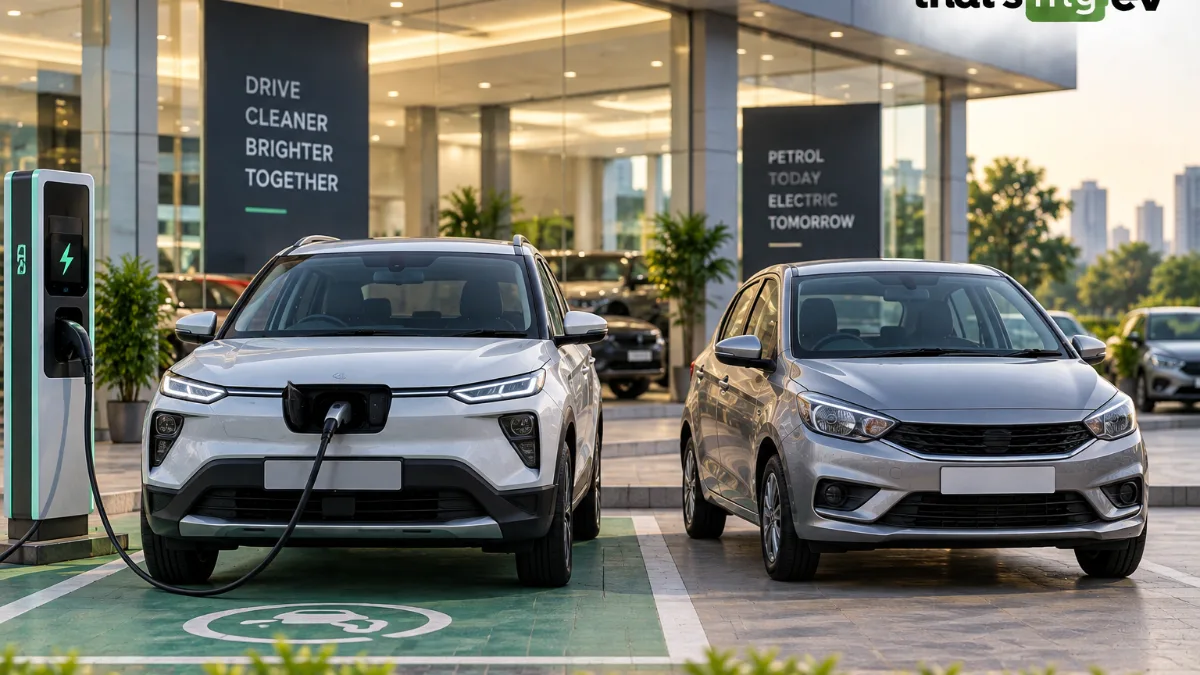
One Year of GST 2.0: An Electric Car's Tax Lead Over a Small Petrol Car Has Nearly Halved
GST 2.0 turned one on 22 September 2026, and for anyone shopping for a small electric car, it took away about half of the EV's tax advantage. Nothing changed on the electric side: EVs paid 5% GST before 22 September 2025 and pay 5% now. What changed is the petrol car beside it in the showroom, which went from 29% total tax to 18%.
That matters more now because the government is telling the EV industry to compete on cost. At an interaction the Ministry of Heavy Industries organised at Vigyan Bhawan, New Delhi, Heavy Industries Minister H.D. Kumaraswamy asked the industry to focus on cost competitiveness, technology and global capabilities, according to the PIB account of the event. For a buyer weighing the Tata Punch EV against its petrol twin, the tax gap is the central advantage left, and it is smaller than it was.
What the GST Council Changed
The 56th GST Council cut the rate on small cars from 28% to 18% and moved mid-size and large cars to a flat 40%, both with no compensation cess, effective 22 September 2025, according to the PIB notes on the council's decisions. For GST, a small car is a petrol, LPG or CNG car up to 1,200cc and 4,000mm long, or a diesel car up to 1,500cc and 4,000mm. Anything bigger now pays 40%, including SUVs over 1,500cc and 4,000mm with 170mm or more of ground clearance.
Before the reform, those cars paid 28% GST plus a compensation cess, which the 2017 cess rate notification set at 1% for a small petrol car and 22% for an SUV. Electric cars paid 5% with no cess, and still do.
GST on Cars: Before and After 22 September 2025
Category | Before (GST plus cess) | After | Gap to EV, before | Gap to EV, after |
Small petrol or CNG (up to 1,200cc, up to 4,000mm) | 29% | 18% | 24 points | 13 points |
Small diesel (up to 1,500cc, up to 4,000mm) | 31% | 18% | 26 points | 13 points |
Petrol up to 1,500cc, over 4,000mm | 45% | 40% | 40 points | 35 points |
SUV (over 1,500cc, over 4,000mm, 170mm plus clearance) | 50% | 40% | 45 points | 35 points |
Electric car, any size | 5% | 5% | n/a | n/a |
Rates from the PIB notes on the 56th GST Council decisions and the compensation cess rate notification of 2017, as amended. Gap columns are ThatsmyEV calculations: the petrol or diesel rate minus the 5% EV rate.
GST is not the whole on-road price These are GST rates on the ex-showroom price. Road tax and registration are set by each state, and many states cut or waive them for electric cars, which adds an advantage this table does not show. The rupee examples below use the same pre-tax value for both cars to isolate the tax effect. A real EV usually carries a higher pre-tax price than its petrol twin, so the gap on an actual model will differ. |
What the Change Means in Rupees
Put the same pre-tax value through both rates and the effect is plain. The table below uses ₹10 lakh for a small car and ₹15 lakh for a large SUV, illustrative values rather than the price of any model.
Case | Petrol or diesel tax, before | After | EV tax | EV saving, before | EV saving, after |
Small car, ₹10 lakh pre-tax | ₹2.9 lakh | ₹1.8 lakh | ₹50,000 | ₹2.4 lakh | ₹1.3 lakh |
Large SUV, ₹15 lakh pre-tax | ₹7.5 lakh | ₹6 lakh | ₹75,000 | ₹6.75 lakh | ₹5.25 lakh |
Editorial estimates at the rates in the table above, on illustrative values.
On those figures the small-car saving fell by about 46% and the large-SUV saving by about 22%, by our calculation. The reform cut deepest where most first-time EV buyers shop: the sub-4-metre segment, where the Tata Nexon EV and the Punch EV sit beside petrol versions that now pay 18%.
Running the numbers on a small EV? Get a free expert callback |
The Subsidy Car Buyers Never Had
Talk of EV subsidies ending needs one correction for car buyers. The PM E-DRIVE scheme, in force since 1 October 2024, pays demand incentives for electric two-wheelers, three-wheelers, ambulances and trucks, and grants for buses, chargers and testing agencies, according to the Ministry of Heavy Industries. Private electric cars are not on the list, so there is no central purchase subsidy on a car to withdraw.
The ministry extended PM E-DRIVE to 31 March 2028 for trucks, buses and testing agencies, according to the PIB release of 8 August 2025. None of that moves the price of an electric car. The central lever that does is GST, and GST 2.0 moved it against the smallest EVs.
Who Should Buy What Now
If you are cross-shopping a sub-4-metre EV against its petrol version, tax no longer does most of the work. The EV case now rests on running cost: how far you drive and whether you can charge where you park. Our comparison tool puts both versions side by side, and our home charging guide covers what a 3.3kW or 7.2kW point needs.
Above 4 metres, very little has changed. A petrol or diesel SUV still pays eight times the EV's GST rate, which is why the tax case for the Tata Harrier EV and the Mahindra XEV 9S survives the reform largely intact.
The ThatsmyEV Take
What the government is really doing is stepping back from the price of the car. It never subsidised private electric cars under PM E-DRIVE, and GST 2.0 narrowed the one central advantage they had, not by raising EV tax but by cutting petrol tax. The minister's call for cost competitiveness is that policy said out loud.
What decides whether small EVs hold up is the showroom gap to their petrol twins. With 13 points of GST separating them instead of 24, carmakers have to close more of that gap themselves, through cheaper cells, localisation and volume. Where they have not, a small EV now has to win on running cost alone, and that only works for buyers who drive enough and charge at home.
What we would tell a buyer on 23 September 2026: if your driving is short city commutes and you have no charging point where you park, the petrol Tata Punch is now the easier case against the Punch EV, and GST 2.0 is the reason. If you charge at home and drive daily distances, the Punch EV or Nexon EV still pays back, but compare ex-showroom prices rather than trusting the tax label. Above 4 metres, the EV keeps a 35-point tax lead, and that is where ThatsmyEV sees the electric case strongest.
Frequently Asked Questions
What is the GST on electric cars in India in 2026?
Electric cars pay 5% GST in India, with no compensation cess, and GST 2.0 left that rate unchanged. The 5% applies regardless of the car's size or price, which is why a large electric SUV keeps a much bigger tax advantage than a small electric hatchback.
What is the GST on small petrol cars after GST 2.0?
Small petrol, LPG and CNG cars up to 1,200cc and 4,000mm now pay 18% GST with no cess. Before 22 September 2025, they paid 28% GST plus a 1% compensation cess, a total of 29%, according to the GST Council decisions and the 2017 cess notification.
What is the GST on SUVs after GST 2.0?
SUVs over 1,500cc and 4,000mm with at least 170mm of ground clearance now pay a flat 40% GST with no cess. Before 22 September 2025, they paid 28% GST plus a 22% compensation cess, a total of 50%.
When did GST 2.0 come into effect for cars?
The new GST rates for cars took effect on 22 September 2025, following the 56th GST Council meeting. The same date removed the compensation cess on passenger cars, which had applied on top of the 28% rate since GST began in 2017.
Did GST 2.0 reduce the tax advantage of electric cars?
Yes, the gap narrowed because petrol and diesel cars got cheaper to tax while EVs stayed at 5%. Against a small petrol car, the EV's lead fell from 24 to 13 percentage points; against a large SUV, it fell from 45 to 35 points, by our calculation.
Does PM E-DRIVE give a subsidy on electric cars?
No, PM E-DRIVE does not offer a purchase subsidy on private electric cars. The Ministry of Heavy Industries directs its demand incentives to electric two-wheelers, three-wheelers, ambulances and trucks, with separate grants for buses, public chargers and testing agencies.
Is the Tata Nexon EV still cheaper to tax than the petrol Nexon?
Yes, the Nexon EV pays 5% GST while the petrol Nexon, as a sub-4-metre car with an engine under 1,200cc, now pays 18%. Before GST 2.0, the petrol Nexon paid 29% including cess, so the EV's tax lead has shrunk from 24 to 13 points.
How much GST does an electric car save on ₹10 lakh?
On ₹10 lakh of pre-tax value, an electric car pays about ₹50,000 in GST against ₹1.8 lakh for a small petrol car, a saving of about ₹1.3 lakh, by our estimate. Before GST 2.0, the same comparison gave a saving of about ₹2.4 lakh.
Do states still waive road tax on electric cars?
Many states cut or waive road tax and registration fees on electric cars, but the rules are set state by state and change with each state EV policy. Check your own state's current policy before assuming a waiver, because it can add a large sum to the EV's advantage.
Will EV subsidies end in India?
For private car buyers, there is no central purchase subsidy to end, because PM E-DRIVE never covered electric cars. The main central advantage is the 5% GST rate, and state road tax waivers vary by state and by policy period.
Want a second opinion on EV versus petrol? Ask a TMEV expert on WhatsApp |
Sources
PIB FAQs on the decisions of the 56th GST Council and the PIB press note on GST rates effective 22 September 2025, both accessed 23 September 2026; Notification 1/2017-Compensation Cess (Rate), as amended, for the pre-reform cess rates. Ministry of Heavy Industries note on PM E-DRIVE components, and the PIB release of 8 August 2025 on the PM E-DRIVE extension. The minister's remarks from the PIB account of the Vigyan Bhawan interaction. The gap and rupee figures are our calculations.
Comments
Write your comment on One Year of GST 2.0: An Electric Car's Tax Lead Over a Small Petrol Car Has Nearly Halved
No comments yet. Be the first to share your thoughts.