MG ADAPT Explained: EV, HEV, PHEV and REEV for Indian Buyers
Quick Summary
JSW MG Motor India unveiled MG ADAPT in Gurugram on 16 July 2026, describing it as India’s first multi New Energy Vehicle platform (manufacturer claimed).
ADAPT stands for Advance Drive Architecture Platform Technology and supports EV, HEV, PHEV and REEV powertrains on one modular architecture (documented).
MG has confirmed one EV and one PHEV will debut on the platform by FY2026-27 (manufacturer claimed).
The platform switches automatically between four modes: Pure Electric Drive, Series Hybrid Drive, Parallel Hybrid Drive and Engine Direct Drive (manufacturer claimed).
MG describes the package as including India’s first 10-in-1 intelligent electric drive unit and the world’s first electromagnetic dedicated hybrid transmission. Both are the company’s own claims and we have not verified either (manufacturer claimed).
A REEV never drives its wheels with the engine, which makes it the format best suited to India’s thin fast-charging network (editorial analysis).
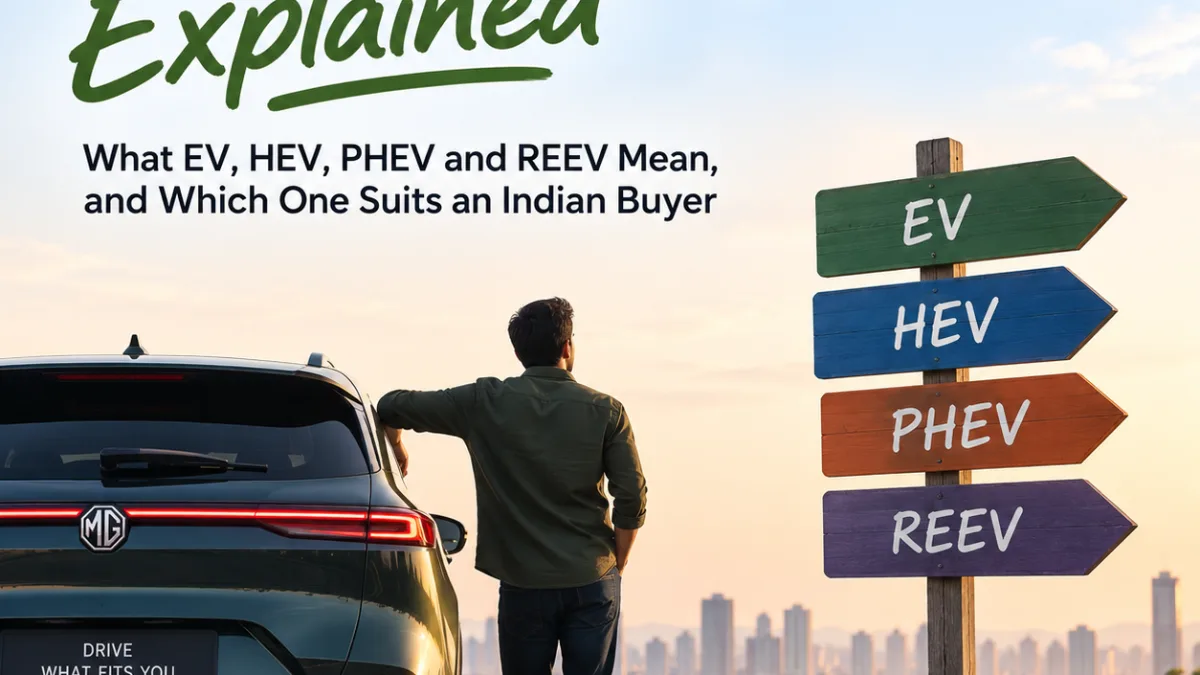
MG ADAPT Explained: What EV, HEV, PHEV and REEV Mean, and Which One Suits an Indian Buyer
JSW MG Motor India unveiled a platform in Gurugram on 16 July 2026 called MG ADAPT, and confirmed that one electric car and one plug-in hybrid will be built on it by FY2026-27. The interesting part is not either car. It is that the same architecture is designed to carry four different electrified powertrains, and that Indian showrooms are about to start using four acronyms at buyers who have spent a decade only needing one.
So this piece is the terminology, not the platform. ADAPT stands for Advanced Drive Architecture Platform Technology, and MG describes it as India’s first multi-energy vehicle platform. What matters to somebody buying a car is the difference between EV, HEV, PHEV and REEV, because those four describe genuinely different ownership experiences. Our EV ownership explainers cover the rest of the vocabulary.
The four formats, in plain terms
Format | Plug in? | Engine drives wheels? | What it is |
EV | Yes, always | No engine | Battery and motor only. What most people mean by an electric car |
HEV | No | Yes | Small battery charged by the engine and by braking. A strong hybrid |
PHEV | Yes, optional | Yes | Larger battery with useful electric-only range, plus a full engine |
REEV | Yes | No, never | Electric drive throughout. The engine only generates electricity |
Format definitions are standard industry terminology rather than MG’s. MG’s own material confirms ADAPT supports all four. Battery sizes, electric-only ranges and prices for any ADAPT product have not been announced.
The distinction that catches people out is between HEV and PHEV. A strong hybrid, an HEV, never gets plugged in: the engine and the brakes charge a small battery, and the car uses it to cut fuel consumption in traffic. A plug-in hybrid has a much larger battery you can charge from a wall, giving real electric-only running for a commute, with an engine for everything beyond that. Both have an engine that can drive the wheels. Only one of them ever needs a charging cable.
Why REEV is the one to watch in India
A range extender is a full electric car with a generator on board. The wheels are turned by an electric motor at all times. The engine never connects to the drivetrain; it runs at whatever speed is most efficient, makes electricity, and tops up the battery. You drive it like an EV, you charge it like an EV, and when you are somewhere without a charger, it keeps going on petrol. Given that India has 16,561 public charging stations carrying a fast charger a car can use, as set out in our charging network coverage, that is a format built for exactly the problem Indian buyers keep describing.
The trade-off is that you carry both systems and pay for both. A REEV is heavier than an equivalent EV, its engine is dead weight on every journey you complete on battery alone, and it needs servicing, fuel and emissions compliance that a pure EV does not. What it buys is the removal of range anxiety without asking the buyer to rely on a public network that is thin outside the metros.
None of this is a price or a product yet MG has announced a platform and confirmed that one EV and one PHEV will arrive on it by FY2026-27. No model names, battery capacities, electric-only ranges, certification figures or prices have been published for any ADAPT product, and MG has not said whether a REEV model is planned for India at all. Everything in this article about what these formats do is general engineering rather than a description of a car you can buy. Treat announcements about future platforms as a signal of direction and nothing more. |
What MG says is inside it
MG describes ADAPT as integrating a dedicated hybrid engine, a dedicated battery system, what it calls India’s first 10-in-1 intelligent electric drive unit, and what it bills as the world’s first electromagnetic dedicated hybrid transmission. Those two superlatives are MG’s own claims, and we have not verified either independently; a segment-first or world-first claim gets attributed to the company making it until somebody else can check it.
An intelligent energy management system switches automatically between four drive modes: Pure Electric Drive, Series Hybrid Drive, Parallel Hybrid Drive, and Engine Direct Drive. Series and parallel describe the two ways a hybrid can arrange itself. In series, the engine only generates electricity and the motor drives the wheels, which is how a REEV always operates. In parallel, the engine can drive the wheels directly. A platform able to do both, and to hand over between them without the driver noticing, is what allows one architecture to underpin four different products.
What we still do not know
Which models arrive on ADAPT. MG has confirmed one EV and one PHEV by FY2026-27 but has named neither.
Whether a REEV is planned for India. The platform supports the format; MG has not said it will build one here.
Battery capacities, electric-only ranges and certification figures for any ADAPT product. None has been published.
Pricing, and whether ADAPT products sit above or below the existing MG range.
Whether the 10-in-1 drive unit and the electromagnetic transmission perform as described. Both are manufacturer claims awaiting independent measurement.
Working out whether an EV, a hybrid or a plug-in fits how you drive? |
The ThatsMyEV Take
What MG is really doing is hedging, and sensibly. Building one architecture that can carry four powertrains means the company does not have to bet correctly on how fast Indian charging infrastructure improves. If it improves quickly, ADAPT builds EVs. If it does not, the same platform builds range extenders and plug-in hybrids, and MG sells electric driving to people who cannot charge at home. Anyone shopping the current MG electric range should read this announcement as a statement about the next five years rather than the next five months.
The thing that will decide whether it works is honesty in the showroom. Four acronyms is three more than most Indian buyers have needed, and the two that will be abused are HEV and PHEV. A strong hybrid sold as an electrified car to somebody who believes they are buying something they can plug in is a complaint waiting to happen, and it is the single most predictable mis-selling risk of the next two years. If MG publishes electric-only range figures prominently on its PHEV and states plainly that its HEV cannot be plugged in, the format range is a genuine service to buyers. If it leads with the word electrified and lets the customer work it out, it is not.
Our advice as of 13 September 2026, for anyone who will be offered one of these: ask two questions and ignore the brochure. First, can I plug it in? That separates HEV from everything else. Second, can the engine turn the wheels? That separates a REEV from a PHEV. If you charge at home and drive under about 60km a day, a pure EV remains the cheapest car to run and nothing here changes that. If you cannot charge where you park, a REEV is the format worth waiting for, and MG has not yet confirmed one for India.
Frequently Asked Questions
What is the MG ADAPT platform?
MG ADAPT, short for Advanced Drive Architecture Platform Technology, is a modular vehicle architecture unveiled by JSW MG Motor India in Gurugram on 16 July 2026. MG describes it as India’s first multi-energy vehicle platform, designed to support electric, hybrid, plug-in hybrid and range extender powertrains on one common structure.
What does REEV mean?
REEV stands for Range Extender Electric Vehicle. The wheels are driven only by an electric motor, and a petrol engine on board acts purely as a generator, making electricity to top up the battery. The engine never connects to the drivetrain. You drive and charge it like an electric car, but it does not stop when the battery runs low.
What is the difference between a PHEV and a strong hybrid?
A plug-in hybrid has a large battery you charge from a wall socket or charger, giving meaningful electric-only running before the engine is needed. A strong hybrid, or HEV, is never plugged in: its smaller battery is charged by the engine and by braking, and it exists to cut fuel consumption rather than to replace it.
Do you need to plug in a strong hybrid?
No. A strong hybrid charges its own battery through the engine and through regenerative braking, and has no charging port for external power. If a salesperson describes a car as electrified, ask directly whether it can be plugged in. That single question separates a strong hybrid from a plug-in hybrid, a range extender and a full electric car.
Which cars will use the MG ADAPT platform?
MG has confirmed that one electric vehicle and one plug-in hybrid will debut on ADAPT by FY2026-27, but has not named either model. No battery capacities, ranges or prices have been announced for any ADAPT product, and MG has not confirmed whether a range extender model is planned for India.
Is a range extender better than an electric car in India?
It depends on whether you can charge where you park. India has 16,561 public charging stations with a fast charger suitable for cars, so a driver without home charging faces real inconvenience with a pure EV. A range extender removes that problem at the cost of extra weight, an engine to service, and fuel to buy. If you can charge at home, a pure EV is cheaper to run.
What are the four drive modes on MG ADAPT?
MG lists Pure Electric Drive, Series Hybrid Drive, Parallel Hybrid Drive and Engine Direct Drive, switched automatically by an intelligent energy management system. In series mode, the engine only generates electricity while the motor drives the wheels. In parallel and direct modes, the engine can drive the wheels itself.
What is a 10-in-1 electric drive unit?
It refers to integrating ten separate electrical and drivetrain components into a single assembly, which reduces weight, packaging space, and cost compared with housing each separately. MG describes its unit as India’s first of this type. That is the company’s own claim, and we have not verified it independently.
When will MG ADAPT cars launch in India?
MG has said one EV and one PHEV will debut on the platform by FY2026-27, which ends on 31 March 2027. No specific launch dates, model names or prices have been announced. Until MG publishes a product, the announcement is a statement of technical direction rather than something a buyer can act on.
Is a PHEV worth buying in India?
It suits a specific driver: someone who can charge at home, whose daily running fits inside the electric-only range, and who also makes regular long trips where charging is inconvenient. If you rarely drive long distances, a pure EV is cheaper. If you never charge at home, the plug-in battery is dead weight and a strong hybrid or range extender makes more sense.
Want to know which powertrain actually suits your daily running? |
Sources
JSW MG Motor India press release, "JSW MG Motor India Unveils MG ADAPT, India’s First Multi New Energy Vehicle Platform", dated Gurugram, 16 July 2026, published on the MG Motor India newsroom and accessed 13 September 2026. From that release: the ADAPT acronym, the description of the platform as India’s first multi New Energy Vehicle architecture, its support for EV, HEV, PHEV and REEV powertrains, the confirmation that one EV and one PHEV will debut by FY2026-27, the dedicated hybrid engine and dedicated battery system, the 10-in-1 intelligent electric drive unit, the electromagnetic dedicated hybrid transmission, the intelligent energy management system and the four drive modes. The India-first and world-first descriptions are MG’s own marketing claims and are reported here as such rather than verified. The 16,561 figure for public charging stations carrying a fast charger suitable for cars comes from a written reply to an unstarred question in the Lok Sabha, 21 July 2026, by the Minister of State for Heavy Industries. Definitions of EV, HEV, PHEV and REEV, and the series and parallel hybrid explanations, are standard engineering terminology rather than MG’s wording. Still open: model names for the confirmed EV and PHEV; whether any REEV is planned for India; battery capacities, electric-only ranges and certification figures for any ADAPT product; pricing; and independent verification of the 10-in-1 drive unit and the electromagnetic transmission. A product launch would settle most of these. We have not driven anything on this platform, so no ThatsMyEV measured figures appear here; that work sits in our expert reviews.
Comments
Write your comment on MG ADAPT Explained: What EV, HEV, PHEV and REEV Mean, and Which One Suits an Indian Buyer
No comments yet. Be the first to share your thoughts.