JSW Ampstar Electric Trucks and Buses Launched: A ₹2,500 Crore Bet on a Segment PM E-DRIVE Has Barely Moved
Quick Summary
JSW Greentech launched the Ampstar brand for electric buses and trucks on 22 September 2026 (JSW press release).
Plant at AURIC, Chhatrapati Sambhajinagar: 90 acres, 15,000 vehicles a year.
First-phase investment of ₹2,500 crore, per Parth Jindal at the launch.
First truck is a 55-tonne tractor-trailer; buses span 7 to 18 metres.
PM E-DRIVE had supported 53 electric trucks against a target of about 5,600 (Heavy Industries Minister, 2 September 2026).
Localisation at 50%, with LFP cells and motor magnets still imported.
Price, battery capacity and range: not published by JSW
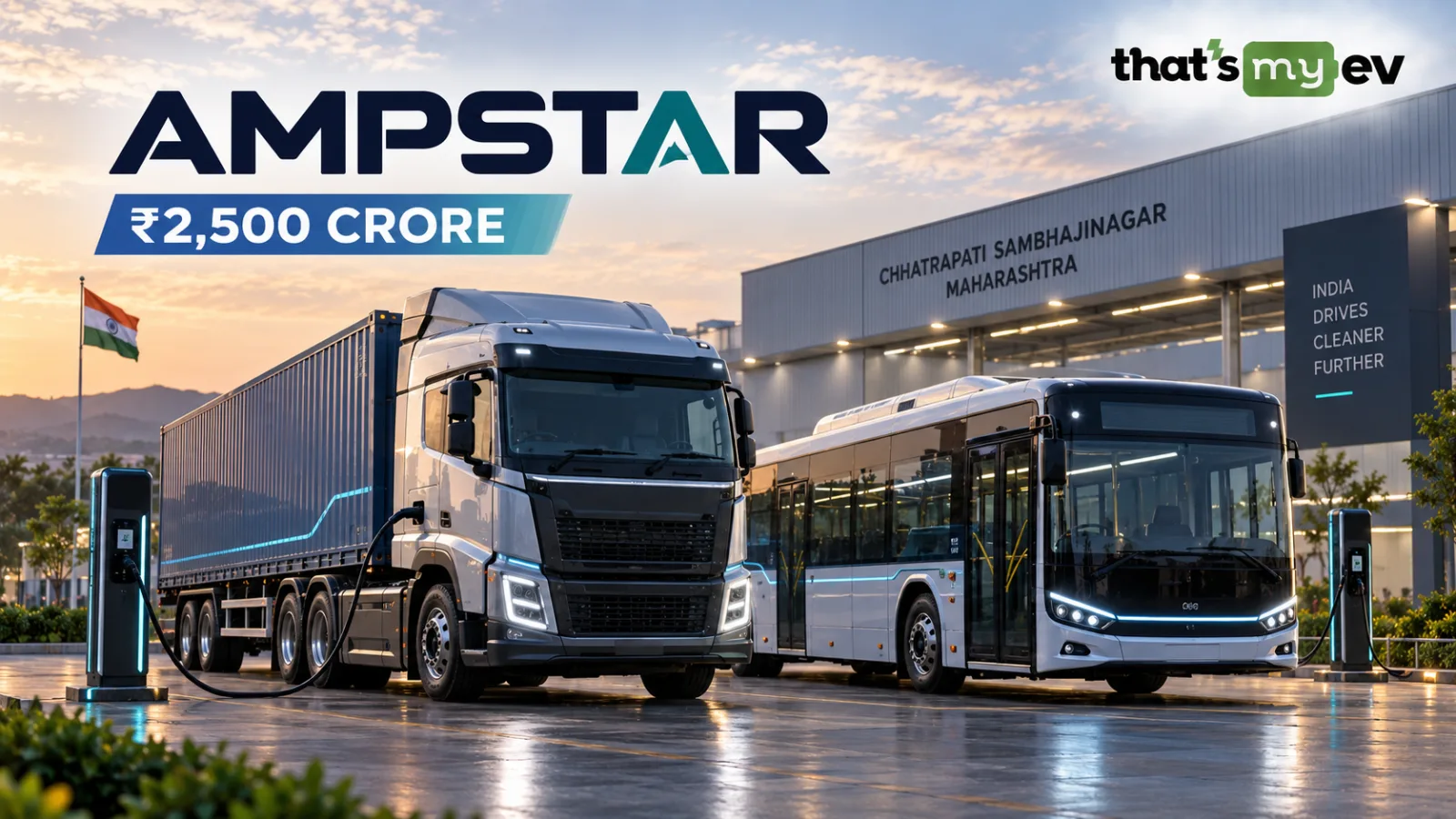
JSW Ampstar Electric Trucks and Buses Launched: A ₹2,500 Crore Bet on a Segment PM E-DRIVE Has Barely Moved
JSW Greentech launched Ampstar, its brand for electric buses and trucks, in Mumbai on 22 September 2026, and its first truck is a 55-tonne tractor-trailer. That sits at the top of the weight range the government's PM E-DRIVE truck incentive covers, and as of 2 September 2026 the scheme had supported 53 electric trucks in total, against a target of about 5,600.
JSW is entering the one segment where the government's own incentive has barely moved anything, with a ready customer in its own steel, cement and port businesses. For readers who know JSW as the group behind JSW MG Motor India and the MG Windsor EV, this is the first JSW vehicle built on a drivetrain the group says it wrote itself.
What JSW Has Confirmed
JSW's press release, dated 22 September 2026, confirms the brand, the plant and the product plan. Ampstar vehicles will be built on a 90-acre site at AURIC in Chhatrapati Sambhajinagar, Maharashtra, which JSW describes as India's largest integrated EV manufacturing facility, with capacity for 15,000 buses and trucks a year. The site will also assemble battery packs and truck cabins.
JSW Ampstar: Key Specifications
Item | Figure |
Launch | 22 September 2026, Mumbai |
Plant | AURIC, Chhatrapati Sambhajinagar, 90 acres |
Annual capacity | 15,000 vehicles (10,000 buses and 5,000 trucks, per Parth Jindal) |
First-phase investment | ₹2,500 crore (Parth Jindal at the launch) |
Power configurations | 150kW to 500kW |
Bus lengths | 7 to 18 metres |
First truck | 55-tonne tractor-trailer |
Next trucks | Tippers and fixed-body dumpers |
Ownership models | Purchase, leasing, battery as a service |
Localisation | 50% now, 75% targeted in 9 to 12 months (Sumit Mittal) |
Price, battery capacity, range | Not published |
Figures from JSW Group's Ampstar press release of 22 September 2026, accessed 23 September 2026, except rows naming a JSW executive, which come from statements at the launch.
Three things are missing from that list: a price, a battery capacity and a range figure for either vehicle. JSW has not published any of them, and for a fleet buyer they are the numbers that decide whether a 55-tonne electric truck beats diesel on cost per kilometre. JSW Greentech CEO Sumit Mittal said at the launch that the company is aiming for 500 to 1,000 vehicles in its first year, sold directly to businesses rather than through a retail dealer network.
The Scheme Ampstar Is Walking Into
The Ministry of Heavy Industries launched India's first incentive for electric trucks on 11 July 2025, under PM E-DRIVE. The ministry set a target of about 5,600 trucks, with incentives of up to ₹9.6 lakh a vehicle depending on gross weight, for N2 trucks above 3.5 tonnes and N3 trucks up to 55 tonnes. Two conditions come attached: the buyer must hand in a scrapping certificate for an old diesel truck, and the maker must back the battery for five years or 5,00,000 kilometres.
Fourteen months on, the uptake is thin. Heavy Industries Minister H.D. Kumaraswamy told the annual session of the Automotive Component Manufacturers Association on 2 September 2026 that 53 electric trucks had been supported under the scheme. That is under 1% of the target, by our calculation, in a scheme the ministry had already extended to 31 March 2028 for trucks and buses because it judged the electric truck market to be at an early stage.
PM E-DRIVE component | Target or allocation | Status |
Electric trucks | About 5,600 vehicles | 53 supported (2 September 2026) |
Electric buses | 14,028 vehicles, ₹4,391 crore | About 13,800 allocated |
End date, trucks and buses | 31 March 2028 | Extended from 31 March 2026 |
Truck target and incentive from the Ministry of Heavy Industries launch of 11 July 2025. Extension from the PIB release of 8 August 2025. Progress figures from the Heavy Industries Minister's address of 2 September 2026.
Supported is not the same as sold The 53-truck figure counts vehicles that drew the PM E-DRIVE incentive. An electric truck bought without it, for example by a fleet with no diesel truck to scrap, would not appear in that count. The ministry has not published a separate national count of electric truck registrations, so ThatsmyEV treats 53 as a measure of the scheme, not of the market. |
Why JSW Thinks It Can Move Where Others Have Not
JSW's first answer is captive demand. The group's steel, cement and port businesses are served by around 17,000 trucks, JSW officials said at the launch, which gives Ampstar a customer that needs no persuading on routes the group already controls. The release also sells the package rather than the vehicle, bundling charging, financing and after-sales support.
The second answer is engineering JSW says it owns. The release states that JSW Greentech developed the base logic, software and algorithms for the entire electric drivetrain in-house, and Mittal said the company pays no royalty to any partner. That is a departure for the group, whose car business sells MG-brand models developed with its partner SAIC, including the MG ZS EV and the MG M9. JSW has not said whether any Ampstar drivetrain work will reach its passenger cars.
Where the Localisation Claim Stops
Mittal said Ampstar reached 50% localisation in six months and targets 75% within nine to twelve months. He named the two parts still imported: LFP battery cells and the magnets in the motors. If you want the background on why LFP chemistry dominates heavy vehicles and budget cars alike, our guide to EV battery basics covers it.
Those two imports are exactly the dependencies the Heavy Industries Ministry is trying to close, through its ₹18,100 crore PLI scheme for advanced chemistry cells and its programme for sintered rare-earth magnets, both of which the minister cited on 2 September 2026. Nearly every electric car sold in India carries the same two imports. JSW has not named its cell supplier.
Shopping for an electric car rather than a truck? Get a free expert callback |
The ThatsmyEV Take
What JSW is really doing is building a customer before it builds a market. Around 17,000 trucks already work for the group's own businesses, and a 55-tonne tractor-trailer is the vehicle those steel, cement and port routes run on. If JSW moves even a small slice of that fleet to Ampstar, it will have put more heavy electric trucks on the road than the national incentive managed in its first fourteen months.
What decides whether it works is the price and the battery, and JSW published neither on 22 September 2026. A heavy electric truck lives or dies on cost per kilometre against diesel, and the scrappage condition means many fleet buyers will not qualify for the ₹9.6 lakh incentive at all. Until Ampstar publishes a price and a certified range, the ₹2,500 crore is a statement of intent rather than a business case.
What we would tell a reader on 23 September 2026: if you own or are shortlisting an MG electric car, nothing in this launch changes your decision. Ampstar shares a parent group with JSW MG Motor India, not a platform. Judge the MG cars against every electric car on sale in India on their own numbers, and watch JSW's cell sourcing, because a group buying LFP cells at truck volumes has a lever it could later pull for its cars.
Frequently Asked Questions
What is JSW Ampstar?
Ampstar is the brand JSW Greentech launched on 22 September 2026 for electric buses and trucks in India. JSW says it covers the vehicle plus charging, financing, leasing, battery-as-a-service and after-sales support, sold initially to fleet and business customers rather than through retail dealers.
How much is JSW investing in Ampstar?
JSW is investing ₹2,500 crore in the first phase, according to Parth Jindal speaking at the 22 September 2026 launch. The figure does not appear in JSW's written press release, so it rests on that on-record statement.
What is the price of the JSW Ampstar electric truck?
JSW has not published a price for any Ampstar truck or bus as of 23 September 2026. The company says customers can buy outright, lease, or take the battery as a service, which means the effective cost will depend on the ownership model chosen.
What is the range of the JSW Ampstar truck?
JSW has not published a battery capacity or a certified range for the Ampstar truck or bus. The release gives only power configurations of 150kW to 500kW, which describe motor output, not how far the vehicle travels on a charge.
Does the JSW Ampstar truck qualify for the PM E-DRIVE subsidy?
JSW has not said whether Ampstar models are approved under PM E-DRIVE. The scheme covers N3 trucks up to 55 tonnes with incentives of up to ₹9.6 lakh, but only against a diesel truck scrapping certificate and a five-year or 5,00,000 km battery warranty.
How many electric trucks has PM E-DRIVE supported?
PM E-DRIVE had supported 53 electric trucks as of 2 September 2026, according to Heavy Industries Minister H.D. Kumaraswamy. The ministry's target when it launched the truck incentive on 11 July 2025 was about 5,600 trucks.
Is JSW Ampstar related to MG Motor India?
Ampstar and JSW MG Motor India share a parent group but not a platform. JSW says Ampstar's drivetrain software was developed in-house by JSW Greentech, while MG-brand cars are developed with SAIC. JSW has not announced any technology sharing between the two.
How localised is the JSW Ampstar?
Ampstar is at 50% localisation and targets 75% within nine to twelve months, according to JSW Greentech CEO Sumit Mittal. He said LFP battery cells and motor magnets are the two main parts still imported because India's supply chain for both is not yet developed.
When does JSW Ampstar production start?
JSW's press release gives no production start date. JSW officials indicated at the launch that production at the Chhatrapati Sambhajinagar plant would begin about a month after 22 September 2026, which would point to late October 2026, but that date is unconfirmed.
Choosing between electric cars instead? Ask a TMEV expert on WhatsApp |
Sources
JSW Group press release, JSW Group powers into Electric Commercial Mobility with AMPSTAR, 22 September 2026, accessed 23 September 2026. Ministry of Heavy Industries launch of the PM E-DRIVE e-truck incentive, 11 July 2025; PIB release on the PM E-DRIVE extension to 31 March 2028, 8 August 2025; the Heavy Industries Minister's address to the 66th ACMA annual session, 2 September 2026. Investment, vehicle split, localisation and first-year target from statements by Parth Jindal and Sumit Mittal at the launch.
Comments
Write your comment on JSW Ampstar Electric Trucks and Buses Launched: A ₹2,500 Crore Bet on a Segment PM E-DRIVE Has Barely Moved
No comments yet. Be the first to share your thoughts.