Mahindra XUV400 vs Tata Nexon EV (2026): India's Best Mid-Range EV Showdown
Quick Summary
• Nexon EV starts at ₹12.49 lakh; XUV400 starts at ₹15.49 lakh. A ₹3 lakh gap at base
• XUV400 is larger: 4,200 mm vs Nexon EV's 3,994 mm; 378L boot vs 350L
• XUV400 has more power: 150 hp vs 127 hp; more torque: 310 Nm vs 215 Nm
• Nexon EV wins on: 5-star NCAP safety, V2L charging, more features on top spec, better service network
• XUV400 wins on: Larger cabin and rear seat space, higher ground clearance, one-pedal driving capability
• Both support 50 kW DC fast charging and 7.2 kW wall box chargers
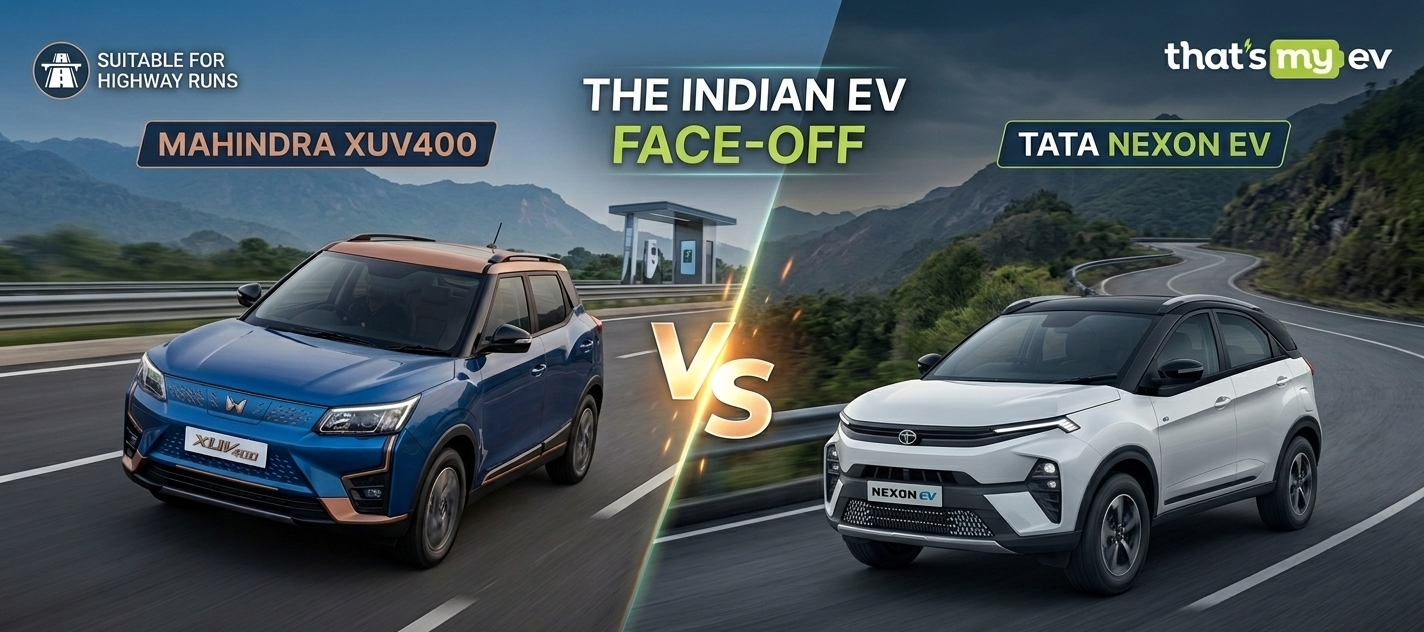
This is the comparison that defines the mainstream Indian EV market. Two homegrown brands, similar price points, similar battery specs, and entirely different personalities.
The Nexon EV built India's EV market almost single-handedly. The XUV400 is the Mahindra challenger that finally gives it serious competition.
Price
Nexon EV starts at ₹12.49 lakh and goes up to ₹17.49 lakh. XUV400 starts at ₹15.49 lakh and goes up to ₹19.19 lakh.
The gap narrows significantly in the middle, and comparable mid-spec variants sit within ₹1–1.5 lakh of each other. At top spec, the Nexon EV is pricier but packs considerably more features for that premium.
Dimensions & Space
The XUV400 is 4,200 mm long versus the Nexon EV's 3,994 mm. It's also wider (1,821 mm vs 1,811 mm), and has more boot space at 378 litres vs 350 litres.
In practice, the space at the back of the XUV400 is significantly better thanks to its longer length and wheelbase. If you're going to spend more time in the back, the XUV400 is a much better bet.
The Nexon EV's rear cabin, while improved, remains somewhat snug; the middle rear seat is best for children. The XUV400's extra length translates to genuinely better adult rear passenger comfort.
The Nexon EV is built on the Nexon platform, which was original ICE (Internal combustion engine) platform made by Tata, and though the XUV400 EV is also made from its parent ICE platform (X100), but it is coming from the product of Ssanyong Tivoli, which was originally imported as CKD and launched as XUV300.
Performance
The XUV400 makes 150 hp and 310 Nm, while the Nexon EV makes 127 hp and 215 Nm. The XUV400 is noticeably punchier in everyday driving.
The XUV400 features an 'L mode' on the drive selector, which significantly increases regenerative braking, enabling one-pedal driving, something the Nexon EV cannot achieve. For urban stop-and-go traffic, one-pedal driving is a daily convenience that experienced EV drivers strongly prefer.
The Nexon EV offers four adjustable regen levels. More granular control, though not strong enough for true one-pedal driving.
Features
The Nexon EV's feature advantage is substantial at top spec: V2L (vehicle to load) charging, 360-degree camera, Arcade.ev app suite for entertainment while charging, wireless Android Auto and Apple CarPlay, automatic headlamps, and ventilated front seats, all are absent on the XUV400.
The XUV400's top variants added dual 10.25-inch screens, dual-zone climate control, and a wireless phone charger, but still trails the Nexon EV on overall feature count.
Safety
The Nexon EV has a 5-star Global NCAP rating, one of the highest safety scores for any Indian EV. The XUV400 has not been NCAP tested. For buyers who prioritise safety ratings in their purchase decision, this is a significant differentiator.
Charging
Both support 50 kW DC fast charging and come with 7.2 kW wall box chargers from the factory and charging times are broadly similar. Neither car has a significant advantage on charging. The Nexon EV's V2L function lets you use the car's battery to power external appliances. The XUV400 doesn't have this.
Verdict
The Nexon EV wins on features, V2L capability, safety rating, design, service network, and overall value at the top spec. The XUV400 wins on rear cabin space, one-pedal driving, ground clearance, and raw performance.
Decision rule: If you have 4–5 adults in the car regularly then XUV400. If you want the most complete EV package with safety credentials and features, go for Nexon EV.
Head-to-Head
Feature | Tata Nexon EV | Mahindra XUV400 |
Starting Price | ₹12.49L | ₹15.49L |
Motor Power | 127 hp / 215 Nm | 150 hp / 310 Nm |
Length | 3,994 mm | 4,200 mm |
Boot Space | 350L | 378L |
One-Pedal Driving | No | Yes (L mode) |
V2L Charging | Yes | No |
NCAP Rating | 5-Star | Not tested |
Service Network | Wider | Growing |
FAQs
1. Which is better: Mahindra XUV400 or Tata Nexon EV? For space and one-pedal driving: XUV400. For features, safety rating, and overall value: Nexon EV. Both are strong; the right choice depends on your specific priorities.
2. Does XUV400 have a better range than Nexon EV? Broadly comparable, both offer 300–400 km real-world range depending on the variant. The XUV400 EL Pro has a slightly larger 40.16 kWh battery vs the Nexon EV's 40.5 kWh; range is nearly identical.
3. Is the Mahindra XUV400 cheaper than the Tata Nexon EV? The XUV400 starts at ₹15.49 lakh and the Nexon EV at ₹12.49 lakh ex-showroom, so the Nexon EV opens lower. Match variants on range and features before comparing, because the gap narrows on the longer-range Nexon EV trims.
4. Does the XUV400 support one-pedal driving? Yes. The XUV400 offers an L-mode that delivers strong regenerative braking and effectively enables one-pedal driving in city traffic, which many owners rate as its standout feature.
5. Which of the two has a better safety rating? The Nexon EV carries a 5-star NCAP rating, while the XUV400 has not been crash-tested under the same protocol. For buyers who treat an independent crash rating as essential, the Nexon EV is the safer documented choice.
6. Which should a first-time EV buyer pick between the two? For most first-time buyers, the Nexon EV is the safer default, given its 5-star rating, V2L, wide variant choice, and Tata's larger service network. Choose the XUV400 if cabin space and one-pedal driving matter most to you.
Compare Nexon EV and XUV400 on-road prices in your city on ThatsmyEV.
Comments
Write your comment on Mahindra XUV400 vs Nexon EV 2026
No comments yet. Be the first to share your thoughts.