EV Charging Time Comparison India (2026): Every Popular Car, Every Charger
Quick Summary • Home AC charging (3.3 kW socket): 8–15 hours depending on battery size • Home wall box (7.2 kW): 4–8 hours, the standard daily charging method • Public DC fast charger (50–80 kW): 40–70 minutes to 80% • Ultra-fast DC (150–350 kW): 18–37 minutes to 80% • The fastest charging EV in India: Kia EV6, 18 minutes from 10–80% on a 350 kW charger • Practical rule: Charge to 80% daily at home, save DC fast charging for road trips
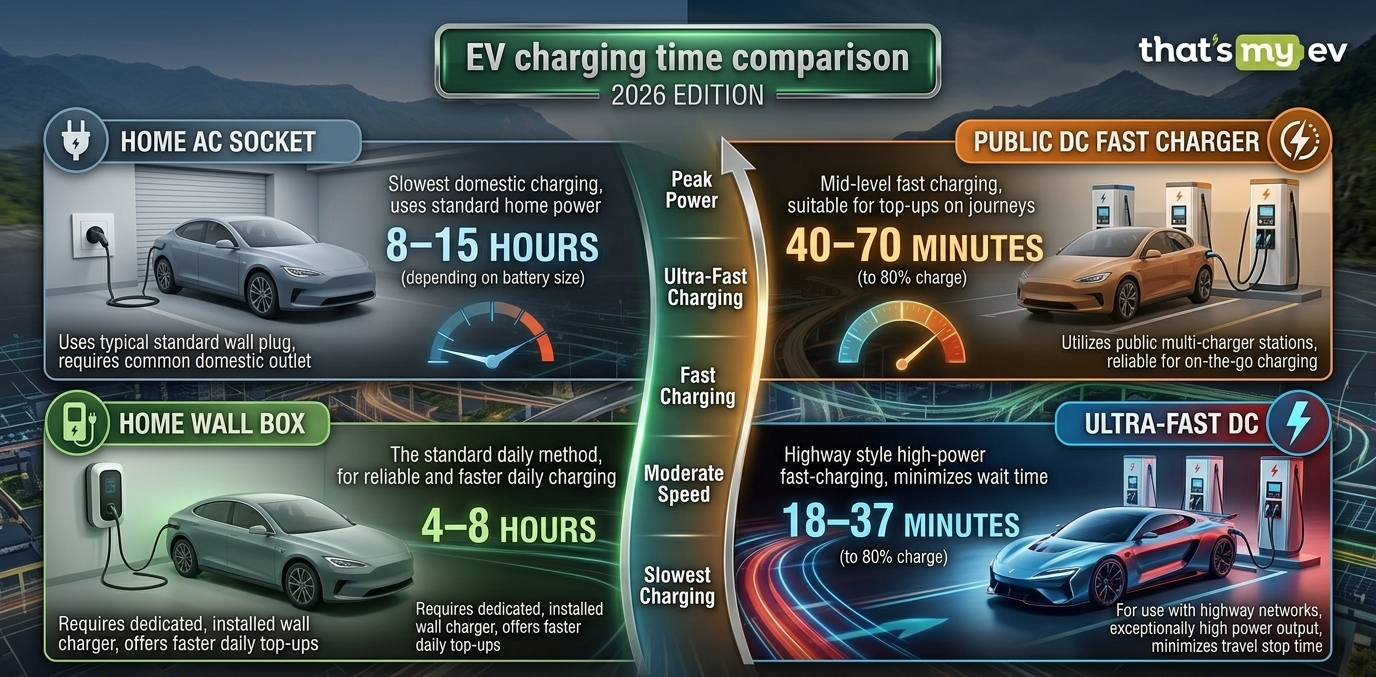
"How long does charging take?" is the question every petrol car owner asks before switching to an EV. The answer varies enormously, from 18 minutes on a 350 kW charger to 12 hours on a standard socket.
Here's a complete, practical charging time guide for every major EV sold in India in 2026.
Charging Time Table: All Major EVs
Car | Battery | 7.2 kW Home (0–100%) | 50 kW DC (20–80%) | Max DC Speed |
MG Comet EV | 17.3 kWh | 3.5 hrs | No DC support | 3.3 kW AC only |
Tata Tiago EV | 24 kWh | 3.6 hrs | 58 min | 25 kW |
Tata Punch EV | 40 kWh | 5.3 hrs | 26 min | 65 kW |
Tata Nexon EV | 45 kWh | ~6 hrs | ~56 min | 50–70 kW |
MG Windsor EV | 52.9 kWh | ~7 hrs | ~60 min | 50 kW |
MG ZS EV | 50.3 kWh | 9 hrs | 60 min | 50–74 kW |
Mahindra BE 6 | 79 kWh | ~10 hrs | <20 min | 175 kW |
Mahindra XEV 9e | 79 kWh | ~10 hrs | <20 min | 175 kW |
BYD Atto 3 | 60.48 kWh | ~9 hrs | 50 min | 80 kW |
BYD Seal | 82.56 kWh | ~10 hrs | 37 min | 150 kW |
Maruti e Vitara | 61 kWh | ~8 hrs | ~50 min | 50 kW |
Hyundai Creta EV | 51.4 kWh | ~7 hrs | 39 min | 50 kW |
Kia EV6 | 84 kWh | ~11 hrs | 18 min (350 kW) | 350 kW |
Hyundai Ioniq 5 | 72.6 kWh | ~9 hrs | 18 min (350 kW) | 350 kW |
Volvo EX40 | 69 kWh | ~9 hrs | 28 min | 150 kW |
What These Numbers Mean in Real Life
Home Charging (the one that matters most)
Level 2 wall box charging at 7.2 kW is the standard for home EV use. It adds 35–40 km of range per hour, fully charging a typical 40 kWh EV battery in 5–6 hours.
In practice: plug in when you park at 9 PM, fully charged by 3–4 AM. Wake up to a full battery every morning. This is the EV ownership experience that makes daily driving completely anxiety-free.
The MG Comet EV's limitation of no DC fast charging means you're entirely dependent on overnight AC charging. That's fine for its 180 km daily use case, but it limits flexibility.
DC Fast Charging (the highway lifeline)
The Mahindra BE 6 and XEV 9e's 175 kW DC charging is transformative, taking 20–80% in under 20 minutes. On a Delhi-Jaipur run, one 20-minute stop is genuinely viable.
The Kia EV6 and Ioniq 5's 350 kW capability means 18 minutes for the same charge, faster than any petrol car fill-up for equivalent range.
For most Indian highway corridors, 50–80 kW DC chargers are more commonly available than 150+ kW. The Punch EV and Nexon EV charge efficiently at those speeds (26–56 minutes to 80%), workable for a meal break.
The 80% Rule: Why You Should Never Charge to 100% on DC
Most DC charging sessions are capped at 80% state of charge to protect the battery. The last 20% can take as long as it takes to charge up to 80%, so charging to 80% and completing to 100% at home overnight is the smart approach.
Charging from 20–80% (the fast zone) on most EVs takes 20–60 minutes. From 80–100% (the slow zone) can take another 30–60 minutes. Stop at 80% for highway stops and complete overnight at home.
FAQs
1. Which EV charges the fastest in India? The Kia EV6 and Hyundai Ioniq 5 both charge from 10–80% in 18 minutes on a 350 kW DC charger, the fastest available in India.
2. How long does it take to charge a Tata Nexon EV at home? On a 7.2 kW home wall box: approximately 6 hours for the 40.5 kWh battery from 0–100%. On a standard 15A socket: 12–14 hours.
3. Can I charge my EV using a regular socket? Yes. All EVs can charge from a standard 15A socket (3.3 kW), but for a 40 kWh+ battery, it takes 12–18 hours. A dedicated 7.2 kW wall box is strongly recommended for daily use.
4. How long does a Mahindra BE 6 take to fast charge? On a 175 kW DC fast charger the BE 6 adds 20 to 80 percent in under 20 minutes. On more commonly available 50 to 60 kW chargers the same top-up takes closer to 45 minutes.
5. Why should I stop charging at 80 percent on a DC charger? Most DC sessions taper sharply after 80 percent to protect the battery, so the final 20 percent can take as long as the first 80. On highways it is faster overall to stop at 80 percent and complete to 100 percent at home overnight.
6. Does fast charging damage the EV battery over time? Occasional DC fast charging is fine, as the battery management system regulates temperature and current. Relying on it daily adds more stress than overnight AC charging, so use fast charging mainly for highway trips and emergencies.
Find DC fast charging stations along your route on ThatsmyEV.
Comments
Write your comment on EV Charging Time Comparison India
No comments yet. Be the first to share your thoughts.