EV vs Petrol Car: Real Cost Per KM in India (2026 Numbers)
Quick Summary
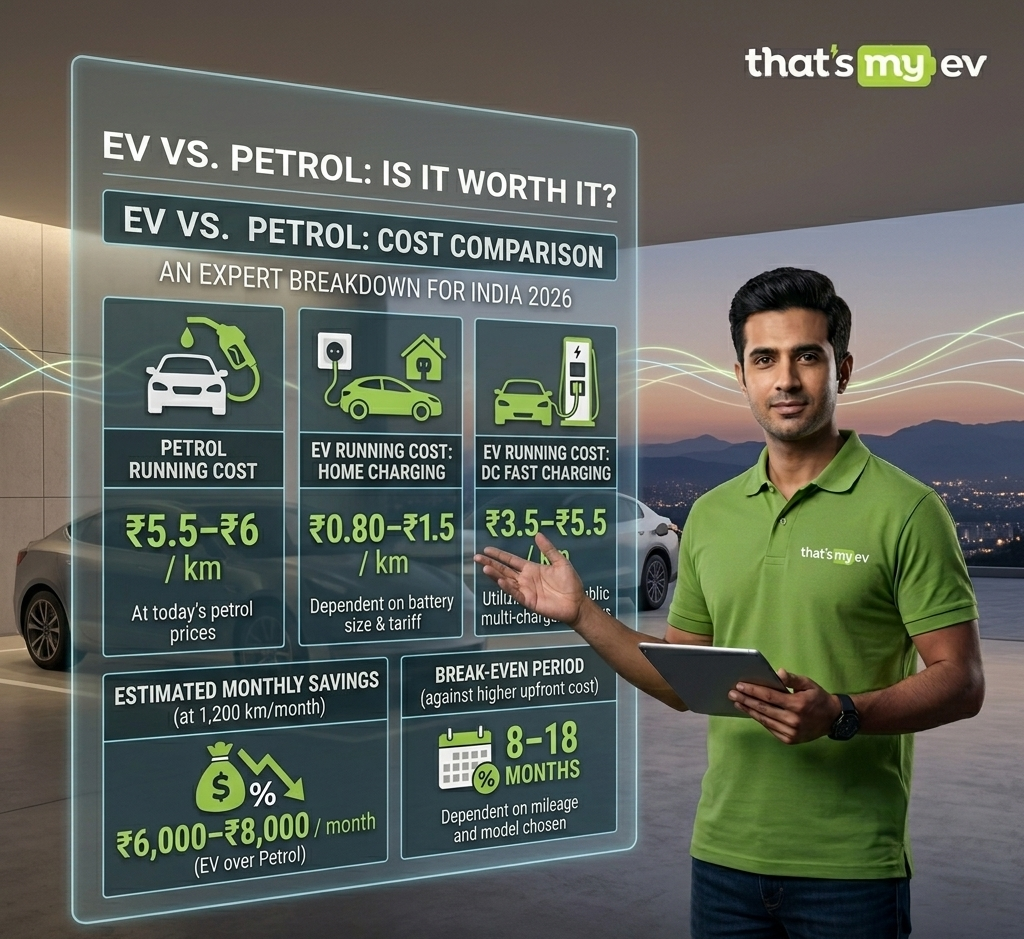
Petrol car running cost: ₹5.5–₹6 per km at today's petrol prices
EV running cost (home charging): ₹0.80–₹1.5 per km, depending on battery size and electricity tariff
EV running cost (DC fast charging): ₹3.5–₹5.5 per km
At 1,200 km/month, an EV saves ₹6,000–₹8,000 per month over petrol
Break-even period against the higher upfront EV cost: 8–18 months, depending on mileage and model
The running cost argument for EVs is simple in theory: electricity is cheaper than petrol. But what do the actual per-kilometre numbers look like in 2026, across different cars, different charging scenarios, and different monthly mileages?
Here are the real numbers, with no marketing and no approximations.
The Base Calculation
With petrol at approximately ₹105 per litre in most Indian cities, a compact SUV averaging 14 km/litre costs ₹7.5 per km. A standard hatchback at 18 km/litre costs ₹5.83 per km. These are fuel costs only. Maintenance adds ₹1–2 per km on top of a 5-year average.
For an EV on home charging at ₹7 per unit (average across Indian states):
Tata Nexon EV (40.5 kWh, 280 km real-world): ₹40.5 × ₹7 ÷ 280 = ₹1.01/km
MG Windsor EV (38 kWh, 240 km real-world): ₹38 × ₹7 ÷ 240 = ₹1.11/km
Mahindra BE 6 (79 kWh, 440 km real-world): ₹79 × ₹7 ÷ 440 = ₹1.26/km
State-by-State Charging Cost Variation
Delhi EV owners on low-consumption electricity slabs pay as little as ₹4.5 per unit, one of the lowest in India, giving running costs below ₹0.75 per km for smaller EVs.
Maharashtra and Karnataka at ₹6–8 per unit push running costs to ₹1–1.5 per km. Tamil Nadu and Kerala, at ₹5–7 per unit, sit in the middle.
Cost per KM Comparison Table
Vehicle | Fuel/Unit Cost | Real-World Efficiency | Cost per KM |
Petrol hatchback (Swift) | ₹105/L | 18 km/L | ₹5.83/km |
Petrol compact SUV (Creta) | ₹105/L | 13 km/L | ₹8.08/km |
CNG hatchback | ₹90/kg | 22 km/kg | ₹4.09/km |
EV (home, Delhi ₹4.5/unit) | ₹4.5/unit | 7 km/unit | ₹0.64/km |
EV (home, ₹7/unit) | ₹7/unit | 7 km/unit | ₹1.0/km |
EV (home, ₹9/unit) | ₹9/unit | 7 km/unit | ₹1.29/km |
EV (DC fast charge, ₹18/unit) | ₹18/unit | 7 km/unit | ₹2.57/km |
EV (DC fast charge, ₹22/unit) | ₹22/unit | 7 km/unit | ₹3.14/km |
Monthly Savings at Different Mileages
For a buyer choosing between Nexon EV (₹14L) and Nexon Petrol (₹12L):
Monthly KM | Petrol Cost | EV (Home) Cost | Monthly Saving |
500 km | ₹3,462 | ₹505 | ₹2,957 |
1,000 km | ₹6,923 | ₹1,010 | ₹5,913 |
1,500 km | ₹10,385 | ₹1,515 | ₹8,870 |
2,000 km | ₹13,846 | ₹2,020 | ₹11,826 |
At 1,000 km/month, the ₹2 lakh price premium between Nexon EV and petrol is recovered in approximately 4 months purely from fuel savings.
The DC Fast Charging Caveat
The moment you shift to primarily public DC fast charging, your effective running cost rises to ₹3.5–₹5.5 per km. That still beats petrol, but the advantage thins significantly.
For buyers without home charging who rely predominantly on public chargers, the EV financial case is real but narrower. Factor this into your calculation before purchase.
5-Year Total Running Cost
At 1,200 km/month over 5 years (72,000 km total):
Petrol Car | EV (Home Charging) | |
Total fuel/charging cost | ₹4.99L | ₹87,000 |
5-year maintenance | ₹1.1L | ₹30,000 |
5-year running total | ₹6.09L | ₹1.17L |
5-year saving: ₹4.92 lakh. This is more than enough to close the upfront EV price premium for most models.
FAQs
Is EV cheaper than petrol per km in India? Yes. An EV costs ₹0.80–₹1.5 per km on home charging versus ₹5.5–₹8 per km for petrol cars. Even DC fast charging at ₹2.5–₹5.5 per km is cheaper than petrol.
At what monthly mileage does an EV make financial sense? At 8,000–10,000 km annually (roughly 700–800 km/month) with home charging, EV ownership makes strong financial sense over a 3–5 year ownership period
Does CNG beat EV on running cost? CNG at ₹4–₹4.5 per km is competitive but doesn't beat EV home charging at ₹0.80–₹1.5 per km. EV wins on running cost; CNG wins on upfront price parity with petrol cars.
How much does it cost to run an EV per km in Delhi? On Delhi's ₹4.5 per unit EV tariff, a Nexon EV costs roughly ₹0.65 per km on home charging. That is well under a rupee per kilometre and among the lowest running costs in the country.
Does public fast charging make EVs as expensive as petrol? No, but it narrows the gap. Public DC fast charging works out to ₹3.5 to ₹5.5 per km, still below petrol's ₹5.5 to ₹8 per km, though far above home charging at under ₹1.5 per km.
How long before EV fuel savings cover the price premium? For buyers driving 1,000 km a month with home charging, monthly savings of ₹5,000 to ₹8,000 plus the Section 80EEB deduction typically recover the EV price premium within 12 to 18 months.
Calculate your exact EV vs petrol savings on ThatsmyEV.
Comments
Write your comment on EV vs Petrol Cost Per KM India 2026
No comments yet. Be the first to share your thoughts.