Delhi to Jaipur in an EV (2026): The Complete Road Trip Guide
Quick Summary
Delhi to Jaipur via NH48 is approximately 280 km, one of India's best EV highway corridors
NH48 was a pilot E-Highway corridor under NHEV, with DC fast chargers available at Manesar, Behror, Neemrana, Shahjahanpur, and Jaipur
For an EV with 300 km range, the Delhi-Jaipur trip requires just one charging stop of 25–30 minutes at Behror (~150 km from Delhi)
Total journey time in an EV: approximately 5 hours 30 minutes vs 5 hours 20 minutes in a petrol car, just 10 minutes extra
Charging cost on EV: approximately ₹380 for the full trip vs ₹1,980 in a petrol car, a saving of ₹1,600 per one-way trip
Apps needed: Statiq, Tata Power EZ Charge, ThatsmyEV
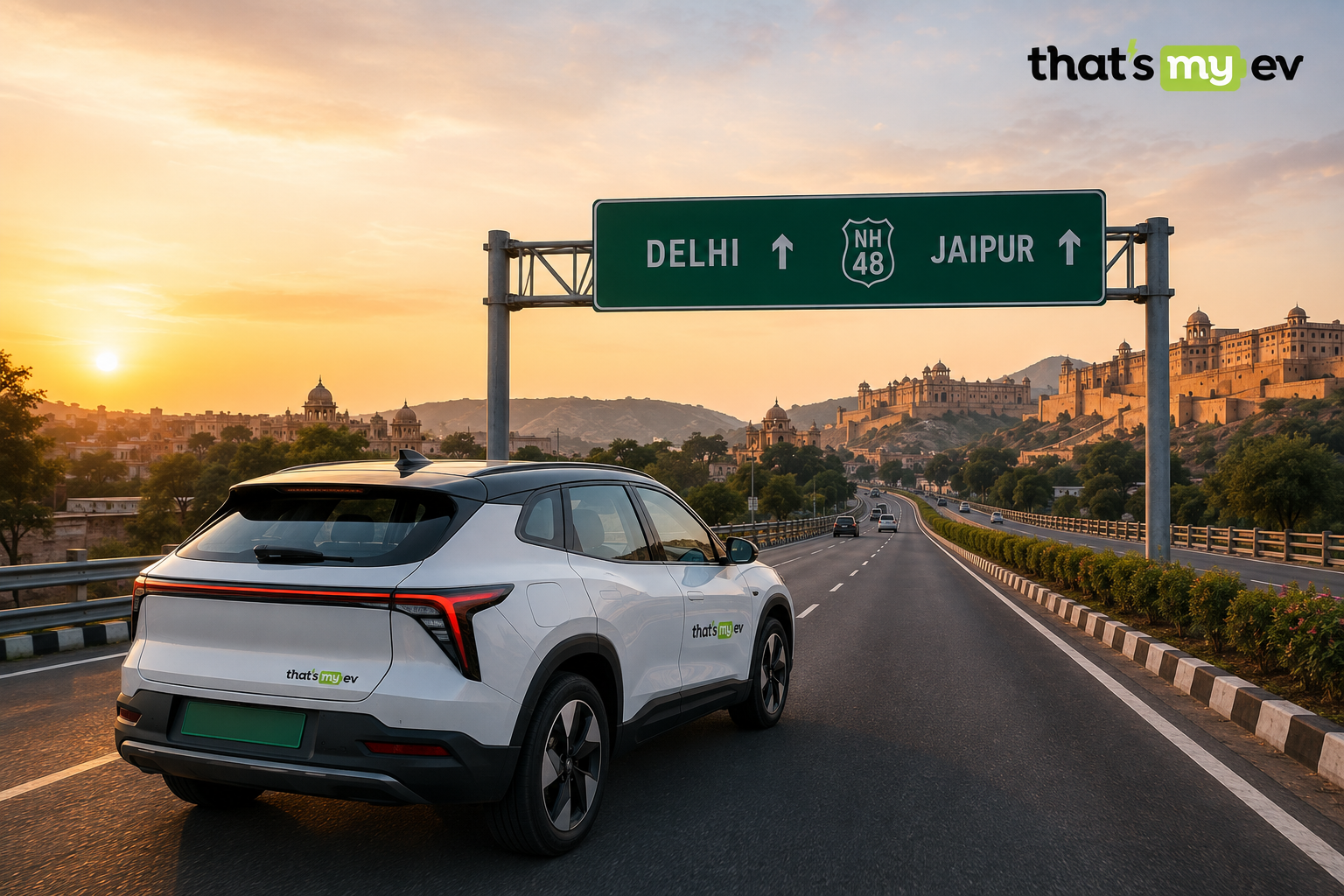
Delhi to Jaipur is 280 km. One of India's better-supported EV highway corridors. A journey that two years ago required careful planning and some anxiety is, today in 2026, genuinely easier in an EV than it sounds. This guide gives you everything you need: route, charging stops, real-time apps, and what to expect.
Before You Leave: Preparation Checklist
Start with a 100% charge from home. Delhi's EV tariff at ₹4.5/unit means a full Nexon EV 45 kWh charge costs approximately ₹202. Starting full eliminates any range anxiety for the first 250 km.
Check charger availability: Open PlugShare or Statiq before departure and verify the Behror chargers show green status. If any are occupied or offline, the backup is the Neemrana charger 30 km further.
Highway range adjustment: At 100–110 km/h on NH48 with AC, expect real-world range to be 15–20% below your city figure. A Nexon EV 45 kWh delivering 320 km in city conditions will do 260–280 km on the highway. Plan your stop accordingly.
The Route and Charging Stops
Delhi-Jaipur via NH48 is one of the best EV-compatible corridors in India. Well-maintained expressways and dense urban clusters mean frequent public charging stations, often at food plazas and hospitality hubs.
Delhi → Neemrana (150 km): First charging opportunity
Drive from Delhi through Gurgaon onto NH48. The first 150 km are comfortable for any EV with 250+ km range. Behror has 60 kW chargers installed by Statiq at two hotels, Highway King and Highway Xpress, separated by 5 km. Both have dual-gun chargers, so two cars can charge simultaneously. At 60 kW, adding 80 km of range takes approximately 20–25 minutes, so time your lunch or chai stop here.
Neemrana → Behror (additional 30 km if needed)
Neemrana, 120 km from Delhi, is a key pit stop. Tata Power EZ Charge and BPCL Charging both have fast chargers conveniently off NH48. The Neemrana Fort Palace makes it an excellent stretch-your-legs opportunity. If you charge at Behror, you won't need Neemrana, but it's there as a backup.
Behror → Shahjahanpur → Jaipur
The final 130 km to Jaipur is straightforward. Shahjahanpur, 60 km from Jaipur, has Tata Power and Fortum fast chargers close to the highway, useful if your battery is lower than comfortable heading into Jaipur. Once in Jaipur, the charging network is well-established, with Tata Power in Vaishali Nagar and C-Scheme, and Fortum stations across key city areas.
Which EVs Can Do Delhi-Jaipur Without Stopping?
Car | Highway Range | Non-Stop Feasible? |
|---|---|---|
Tata Tiago EV (24 kWh) | 180–200 km | No, 2 stops needed |
Tata Nexon EV (30 kWh) | 240–260 km | Marginal, plan a stop |
Tata Nexon EV (45 kWh) | 270–300 km | Yes, arrives near empty in Jaipur |
MG Windsor EV (52.9 kWh) | 250–290 km | Borderline, plan a stop |
Mahindra BE 6 (79 kWh) | 380–430 km | Comfortably yes |
Kia EV6 / Ioniq 5 | 450–540 km | Yes, with range to spare |
Cost Comparison: EV vs Petrol
If you use a petrol car, the petrol costs would be around ₹1,980 for Delhi-Jaipur. In an electric car, the charging costs work out to approximately ₹380, a saving of ₹1,600 per one-way trip. A return trip saves ₹3,200. Over monthly Jaipur visits, annual savings cross ₹38,000, more than enough to justify the EV premium on long-term cost alone.
Highway Driving Tips for EVs on NH48
Use Eco mode for the first 50 km while AC cools the cabin, then switch to Normal for comfortable cruising. Maintain 95–100 km/h rather than 120 km/h; the range difference at speed is significant. Use regenerative braking at every traffic slowdown; it adds range on highway drives more than most owners expect.
Avoid charging immediately after arriving at a charger if the battery is very hot from sustained driving. A 5-minute rest helps the battery thermal management settle before fast charging, protecting long-term battery health.
Charging information last verified: August 19, 2026
Charger availability, pricing, connector availability, and operating hours can change. Check the operator app before departure and keep a backup charging stop in your plan.
FAQs
Can I drive Delhi to Jaipur in a Tata Nexon EV without charging? The 45 kWh Nexon EV can do it on a single charge if you start full and drive at 95–100 km/h with moderate AC. The 30 kWh variant needs one charging stop of 20–25 minutes at Behror.
Where are the charging stations between Delhi and Jaipur? Key charging points on NH48: Manesar, Dharuhera, Behror, Neemrana, Shahjahanpur, and multiple locations in Jaipur itself. PlugShare shows real-time availability for all networks.
How long does Delhi to Jaipur take in an EV? Approximately 5 hours 30 minutes total, including one 30-minute charging stop, only 10 minutes more than the same journey in a petrol car.
How much does the Delhi to Jaipur EV trip cost in charging? Charging works out to roughly ₹380 for the one-way trip against about ₹1,980 in petrol, a saving of ₹1,600 each way, or ₹3,200 on a return run.
Where should I make my charging stop on NH48? Behror, about 150 km from Delhi, has 60 kW Statiq chargers at two hotels with dual guns. Time a 20 to 25 minute lunch or chai break there, and treat Neemrana as a backup if needed.
What driving tips maximise EV range on the Delhi to Jaipur run? Cruise at 95 to 100 km/h rather than 120, use Eco mode while the AC cools the cabin, and lean on regenerative braking at every slowdown. Let a hot battery rest five minutes before fast charging.
👉 Plan your EV road trip route with charging maps on ThatsmyEV.
Comments
Write your comment on EV Road Trip Guide: Delhi to Jaipur
No comments yet. Be the first to share your thoughts.