EV Myths in India Busted (2026): Battery, Fire Risk, Cost & Range Anxiety — The Truth
Quick Summary • EV fires are significantly rarer than petrol car fires, not more common • Modern EV batteries last 15–20 years with gradual range loss, not sudden failure • 75% of Indian commuters drive under 35 km a day. Range anxiety is largely irrelevant for this group • EV battery costs have fallen by over 85% in the past decade. EVs are becoming price-competitive with petrol cars faster than expected • EVs cost 60–70% less to maintain annually than petrol cars
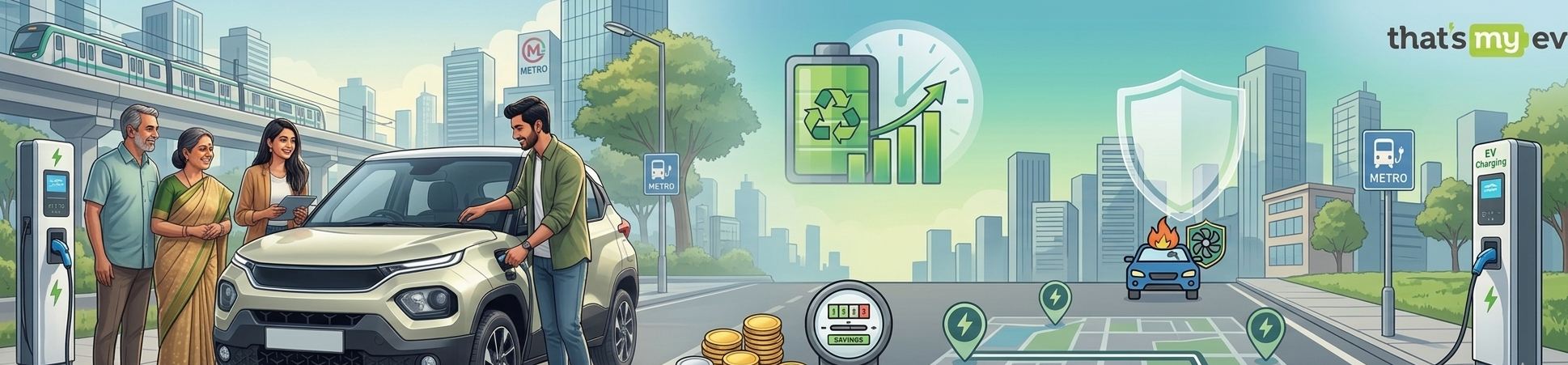
You've heard them all. "EV batteries die in 3 years." "EVs catch fire easily." "They're too expensive to make sense." "You'll get stranded with a dead battery." These claims circulate in WhatsApp groups, colony parking lots, and YouTube comments with remarkable persistence, usually from people who haven't owned or deeply researched an EV.
Let's go through each one with actual data.
Myth 1: EV Batteries Die Quickly, Like Phone Batteries
This is the most persistent and most wrong myth.
Your phone battery degrades badly because it has no thermal management, no smart charging controller, and takes hundreds of full charge cycles a year. An EV battery has all three: a sophisticated Battery Management System monitors every cell, prevents overcharging, manages heat, and controls charging rate.
Real-world data from over 22,700 EVs shows average battery degradation of just 2.3% per year, meaning after 5 years, a car with 320 km of range retains approximately 285–295 km. That's not catastrophic, that's barely noticeable in daily use.
Modern EV batteries are designed to last 15–20 years with gradual range loss rather than sudden failure. Completely unlike phone battery behaviour.
All major manufacturers, e.g., Tata, MG, Mahindra, Kia, back this with 8-year battery warranties guaranteeing at least 70% capacity retention. If your battery degrades beyond that within 8 years, they will replace it.
Verdict: Busted. EV batteries in 2026 are engineered assets with warranty protection, not consumer electronics consumables.
Myth 2: EVs Catch Fire Easily
The videos exist. They're real. And they're wildly misleading as a data point.
EVs are 20 times less likely to catch fire than petrol or diesel cars, according to multiple major studies. Petrol cars carry a tank of highly flammable liquid with a hot engine nearby. EVs carry a sealed battery pack with thermal sensors, a Battery Management System, and cell-level protection.
The persistent claim that EVs catch fire easily is an urban myth. Research into actual fire incidents shows EVs combust at dramatically lower rates than their petrol and diesel equivalents.
Why do the videos go viral? Videos of vehicle fires generate massive engagement because they're shocking. But they represent isolated incidents while ignoring the overwhelming statistical evidence that EVs are the safer vehicles on the road.
The incidents that did occur in India. Primarily involving two-wheeler EVs in 2022, were linked to battery packs not meeting AIS 156 safety standards. Four-wheeler EVs from established manufacturers Tata, MG, Mahindra, and Hyundai are built to strict safety standards and have had no comparable fire incidents at scale.
Modern EVs follow strict Indian safety standards AIS 156 and AIS 038, and are generally safer than conventional cars when used properly.
Verdict: Busted. EVs are statistically far safer from fire risk than petrol cars. Don't let a viral video override large-scale data.
Myth 3: Range Anxiety Will Leave Me Stranded
This one has a grain of historical truth. Early EVs with 100–120 km real-world range did make long trips genuinely stressful. That world no longer exists.
75% of Indian commuters drive under 1,000 km per month. Roughly 35 km per day. Even the most affordable EV on sale in India, the MG Comet EV, delivers 180–200 km of real-world city range. That covers 5 days of average Indian commuting on a single charge.
The shift with EVs is that convenience moves from the petrol station to your own driveway; you wake up to a full charge every morning without visiting a fuel station. Once that habit sets in, range anxiety doesn't just reduce; it disappears entirely for city users.
For highway trips, the network has expanded significantly. India's public charging infrastructure is growing rapidly, with highway corridors like Delhi-Mumbai, Delhi-Jaipur, and Delhi-Chennai now having DC fast chargers available at regular intervals.
The real question isn't "will I get stranded?". It's "do I have home charging?" If yes, range anxiety is largely irrelevant for your daily life.
Verdict: Mostly busted. Range anxiety is valid for buyers without home charging or those doing frequent, long highway trips. For the vast majority of Indian city drivers, it's a non-issue in 2026.
Myth 4: EVs Are Too Expensive
This myth conflates purchase price with total cost of ownership, two very different numbers.
Yes, a Tata Nexon EV costs ₹12–17 lakh while the equivalent petrol Nexon starts lower. That upfront gap is real. But the comparison doesn't end at the showroom.
Running cost: ₹1–1.5 per km for an EV vs ₹6–8 per km for petrol. At 1,200 km/month, that's a saving of ₹6,000–₹8,000 every single month.
Maintenance: EVs cost ₹3,000–₹5,000 per year to maintain vs ₹10,000–₹25,000 for petrol cars annually.
Tax: EVs attract 5% GST vs 28%+ for petrol cars. Road tax and registration exemptions apply in most states.
EV battery costs have fallen by more than 85% over the past decade, allowing EV prices to steadily decline even as range and performance improve. The purchase price gap is narrowing every year.
Over 5 years at 1,200 km/month, a Nexon EV buyer saves ₹4–5 lakh in fuel alone over the petrol equivalent — which fully closes the upfront price gap and then some.
Verdict: Busted for long-term ownership. EVs cost more upfront. They cost significantly less to run and maintain over any ownership period beyond 2–3 years.
Myth 5: EV Batteries Are Expensive to Replace
Battery replacement costs are real: ₹3–6 lakh depending on the model and pack size. That's a large number.
But context matters. Modern EV batteries are designed to last 15–20 years. Most owners won't need a replacement within their ownership period. All major manufacturers offer 8-year warranties. If your battery fails or degrades beyond 70% capacity within that period, the manufacturer replaces it at no cost.
Real-world data from Indian EV owners consistently shows batteries retaining 90–95% health at 3–4 years and 80–90% at 8 years under normal use. The scenario where a battery needs replacement within a typical 5–7 year ownership period is rare for buyers following standard charging practices.
Myth 6: EVs Are Slow and Boring to Drive
Why These Myths Persist
Electric motors deliver instant torque from zero rpm. Many EVs offer impressive acceleration that surprises even experienced drivers. The Mahindra BE 6 does 0–100 in 6.7 seconds. The Kia EV6 does it in under 5.5. Even the Tata Nexon EV feels noticeably quicker than its petrol equivalent off the line.
In city traffic, where most Indian driving happens, the instant torque response of an EV makes it feel more alive than a petrol car at equivalent speed. You never wait for a gearshift, never hunt for a power band. Every overtaking move and every gap in traffic feels effortless.
EV misconceptions thrive when change happens quickly. Many people still reference 2015-era EV limitations instead of 2026 capabilities, and social media amplifies isolated incidents while ignoring broader trends.
The honest answer: most of these myths were partially true for first-generation EVs sold before 2020. Battery degradation was faster. Fires did occur. Range was genuinely limited. Infrastructure was genuinely sparse.
In 2026, that is not the product you are buying. The gap between perception and reality is the largest it has ever been, and it's costing cautious buyers real money in wasted petrol costs every month.
FAQs
Comments
Write your comment on EV Myths in India Busted (2026): Battery, Fire Risk, Cost & Range Anxiety — The Truth
No comments yet. Be the first to share your thoughts.