Maruti e Vitara Rides a 1,00,000-Unit Japan Export Milestone: What It Means for Indian Buyers
Quick Summary
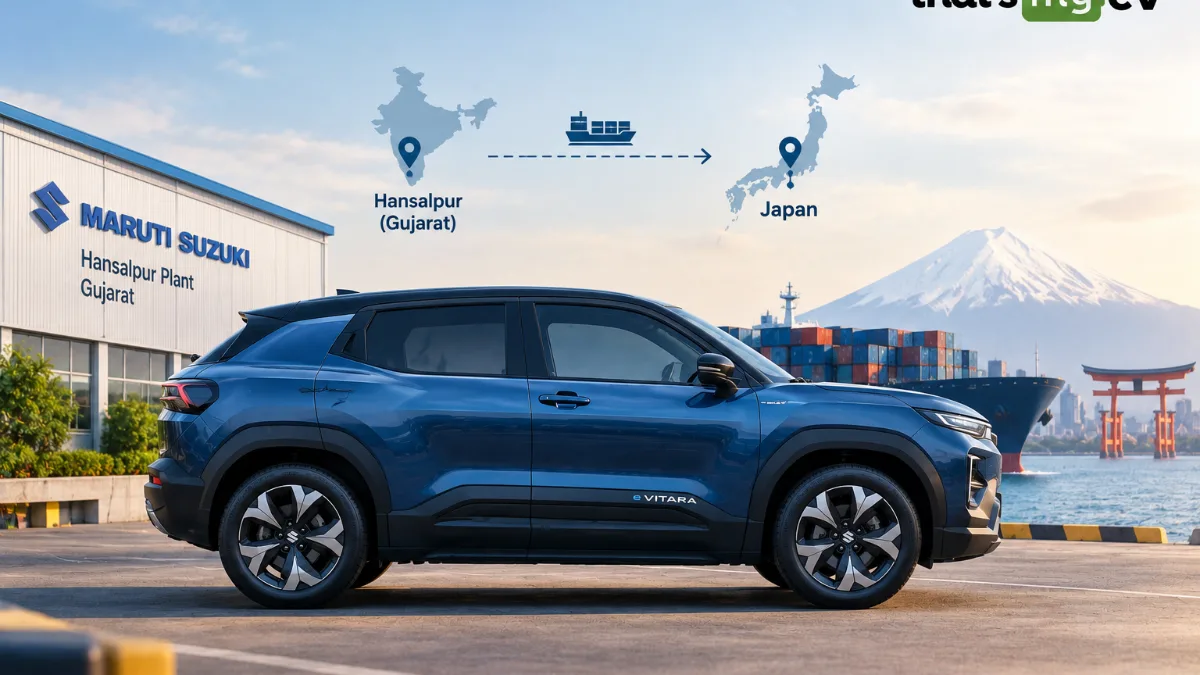
Maruti Suzuki said on 14 September 2026 that cumulative exports of the Jimny 5-door, Fronx and e Vitara to Japan have crossed 1,00,000 units
The e Vitara joined that export list in September 2025, the Fronx in August 2024 and the Jimny 5-door in December 2024
The 1,00,000-unit figure covers all three models together. Maruti has not published an e Vitara-only Japan number
Maruti says it exported more than 1,80,000 vehicles across all markets between April and August of FY2026-27
The e Vitara is built only in India, at Hansalpur in Gujarat, with 49 kWh and 61 kWh battery options
The 61 kWh version is rated at 543 km, ARAI-certified. The 49 kWh version is claimed at 440 km (certified and manufacturer-claimed)
Maruti e Vitara Rides a 1,00,000-Unit Japan Export Milestone: What It Means for Indian Buyers
Maruti Suzuki said on 14 September 2026 that India-built Jimny 5-door, Fronx and e Vitara units shipped to Japan have crossed 1,00,000 cumulatively. Japan was the company’s second-largest export market by volume in FY2025-26, and Maruti says it held that position from April to August of FY2026-27.
For an Indian EV buyer, the interesting part is the third name on that list. The e Vitara is Maruti’s first battery-electric car; it is manufactured only in India, and it was exported before most Indian showrooms had one to sell. That ordering tells you something about how the car is being planned, and it has practical consequences for anyone booking one.
What Maruti Has Confirmed
The company’s statement sets out the sequence. Fronx shipments to Japan began in August 2024, the Jimny 5-door followed in December 2024, and the e Vitara was added in September 2025. Maruti says the Jimny 5-door and the e Vitara are manufactured exclusively in India, which makes Indian plants the sole source for two models sold in Suzuki’s home market.
Managing director and chief executive Hisashi Takeuchi called the milestone "a powerful endorsement of India’s manufacturing excellence". Maruti adds that it supplies close to 120 countries, that it has been India’s largest passenger vehicle exporter from FY2021-22 to FY2025-26, and that Suzuki Motor Corporation became Japan’s largest vehicle importer in FY2025-26, with Maruti-built cars accounting for nearly all of Suzuki’s imports into Japan.
Maruti e Vitara: Key Specifications
Specification | Figure |
Battery options | 49 kWh and 61 kWh |
Power | 144 PS (49 kWh), 174 PS (61 kWh) |
Torque | 192.5 Nm on both |
Range, 61 kWh | 543 km, ARAI-certified |
Range, 49 kWh | 440 km claimed |
Drivetrain | Front-wheel drive, India spec |
Trim levels | Delta, Zeta, Alpha |
Built at | Hansalpur, Gujarat |
Exports to Japan since | September 2025 |
Battery, power, torque and trim figures are from Maruti Suzuki product material for the India-spec car, accessed 16 September 2026. The 543 km figure is ARAI certified; the 440 km figure is the maker’s claim. Export dates are from the company statement of 14 September 2026.
This is a three-model number, not an e Vitara number The 1,00,000-unit milestone covers the Jimny 5-door, Fronx and e Vitara together, and the three started shipping at different times, so it says nothing about the e Vitara’s own run rate in Japan. Export-market range figures also use the WLTP cycle while the India figures above are ARAI, and the two are not comparable. |
Why an export-first EV is a mixed signal for buyers
Scale is the honest upside. An EV programme that ships to Japan and Europe as well as India runs its plant at volumes the domestic market alone would not support. That tends to stabilise component supply, spread the cost of the platform, and give a car a longer production life, which matters to anyone thinking about parts availability and resale five years out.
The downside is allocation. When a plant is serving a booked export order and a domestic order book at the same time, the domestic variant mix is what flexes. The practical version of that for a buyer is simple: the trim and battery you want may have a different wait than the trim the dealer is pushing. Ask for the wait by variant and battery, in writing, before you pay a booking amount.
Maruti has not published a month-wise domestic-versus-export split for the e Vitara, so there is no way from the outside to tell whether a long wait on a specific trim reflects export priority or ordinary demand. That is worth saying plainly rather than guessing at it.
Not sure which e Vitara battery suits your running? Ask a ThatsMyEV expert on WhatsApp |
Price and Rivals
We are not printing a single ex-showroom figure for the e Vitara here. Maruti sells it both outright and through a battery subscription; the entry price differs sharply between those two routes, and the listings we compared on 16 September 2026 did not agree with each other. Confirm the current ex-showroom and on-road price for your variant and city at a Nexa dealership before you plan around a number.
On the road, the e Vitara sits against the Hyundai Creta Electric and the Mahindra BE 6 in the mid-size electric SUV bracket, and you can put them side by side on our compare tool. If you are earlier in the process, the full list of electric cars on sale in India is the better starting point, and our monthly EV sales tracker shows how the segment is actually selling rather than how it is marketed.
What We Still Don’t Know
The e Vitara’s own share of the 1,00,000-unit Japan figure. Maruti reports the three models together.
The month-wise split between e Vitara units built for export and for India, which the company does not publish.
The ThatsMyEV Take
What Maruti is doing with the e Vitara is treating India as a manufacturing base first and an EV market second, and it is being open about it. Exports began roughly six months before Indian deliveries. Japan, a market that is notoriously hard to satisfy on fit and finish, took the car. That is a real engineering signal and worth more to a buyer than any launch-event adjective, because the Japanese domestic market does not accept a car built to a lower standard than its own.
The thing that will decide whether this works for Indian buyers is domestic allocation discipline. An export-anchored plant can absorb a domestic demand spike, or it can leave Indian customers behind an export queue. Maruti has not published the numbers that would tell us which is happening, and until it does, the honest position is that we do not know.
What we would tell a buyer in September 2026: if you want a mid-size electric SUV with a nationwide service network and a plant that is not dependent on Indian EV demand alone, the e Vitara earns a place on the shortlist, and the 61 kWh car is the one to look at because 543 km ARAI gives you genuine highway margin. If you need delivery inside six weeks, get the wait for your exact variant confirmed in writing first, because that is the part of this story nobody publishes.
Frequently Asked Questions
How many cars has Maruti Suzuki exported to Japan?
Maruti Suzuki said on 14 September 2026 that cumulative exports of the Jimny 5-door, Fronx and e Vitara to Japan have crossed 1,00,000 units. The figure covers all three models together rather than any single one. Japan was the company’s second-largest export market by volume in FY2025-26 and Maruti says it held that rank from April to August of FY2026-27.
Where is the Maruti e Vitara manufactured?
The e Vitara is built at Maruti Suzuki’s Hansalpur plant in Gujarat, and the company says it is manufactured exclusively in India. That makes India the sole production source for the model worldwide, including the units sold in Japan and in European markets. The Jimny 5-door is the other Maruti model made only in India.
What is the ARAI range of the Maruti e Vitara?
The 61 kWh e Vitara is rated at 543 km, ARAI-certified. The 49 kWh version carries a claimed 440 km. Export-market versions quote WLTP figures, which are a different test cycle and are not comparable with ARAI numbers. Real-world range on either battery will be lower than the certified figure, and it varies with air-conditioning use, speed, and load.
When did Maruti start exporting the e Vitara to Japan?
Maruti Suzuki added the e Vitara to its Japan export portfolio in September 2025, after the Fronx in August 2024 and the Jimny 5-door in December 2024. Exports of the e Vitara began several months before the model went on sale to Indian customers, which is unusual for an India-built car.
Does Maruti export more e Vitara units than it sells in India?
Maruti has not published a month-wise domestic-versus-export split for the e Vitara, so this cannot be confirmed from the outside. The company has said its overall exports exceeded 1,80,000 vehicles between April and August of FY2026-27 across all models and markets. Any model-level ratio quoted elsewhere is an estimate rather than a company figure.
What battery options does the Maruti e Vitara offer?
The India-spec e Vitara offers a 49 kWh pack making 144 PS and a 61 kWh pack making 174 PS, both producing 192.5 Nm and driving the front wheels. The entry Delta trim uses the smaller battery while the Zeta and Alpha trims use the larger one. Maruti does not offer the dual-motor all-wheel-drive version sold in some export markets in India.
How much does the Maruti e Vitara cost in India?
Maruti sells the e Vitara both outright and through a battery subscription, and the entry price differs substantially between the two routes. The published listings we checked on 16 September 2026 did not agree with each other, so we are not printing a single figure. Confirm the ex-showroom and on-road price for your variant and city at a Nexa dealership.
Is the Maruti e Vitara a good buy compared with the Hyundai Creta Electric?
Both are mid-size electric SUVs at similar positioning, so the decision usually comes down to certified range on the variant you can afford, service reach in your city, and waiting period. The e Vitara’s 543 km ARAI figure on the 61 kWh pack is its strongest card. Compare the exact variants side by side rather than the model names, because trim gaps are wide on both cars.
Why does Maruti export cars to Japan from India?
Maruti Suzuki says Japan has become its second-largest export market by volume and that Suzuki Motor Corporation became Japan’s largest vehicle importer in FY2025-26, with Maruti-built vehicles accounting for nearly all of Suzuki’s imports. Making the Jimny 5-door and e Vitara only in India lets Suzuki use Indian plants to supply its home market.
Does the export programme affect e Vitara waiting periods in India?
There is no published data confirming that it does. A plant serving both an export order book and domestic demand can see domestic variant availability flex, but Maruti does not disclose the allocation split. Ask your dealer for the waiting period on your exact variant and battery in writing before paying a booking amount.
Want a second opinion on which electric SUV fits your usage? Get a free expert callback |
Sources
Maruti Suzuki India company statement on crossing 1,00,000 cumulative exports of the Jimny 5-door, Fronx and e Vitara to Japan, issued 14 September 2026 and accessed 16 September 2026, including the quoted remark by managing director and chief executive Hisashi Takeuchi.
Comments
Write your comment on Maruti e Vitara Rides a 1,00,000-Unit Japan Export Milestone: What It Means for Indian Buyers
No comments yet. Be the first to share your thoughts.