Tata sold 16,549 EVs in August 2026, nearly double last year: what the August sales numbers say
Quick Summary:
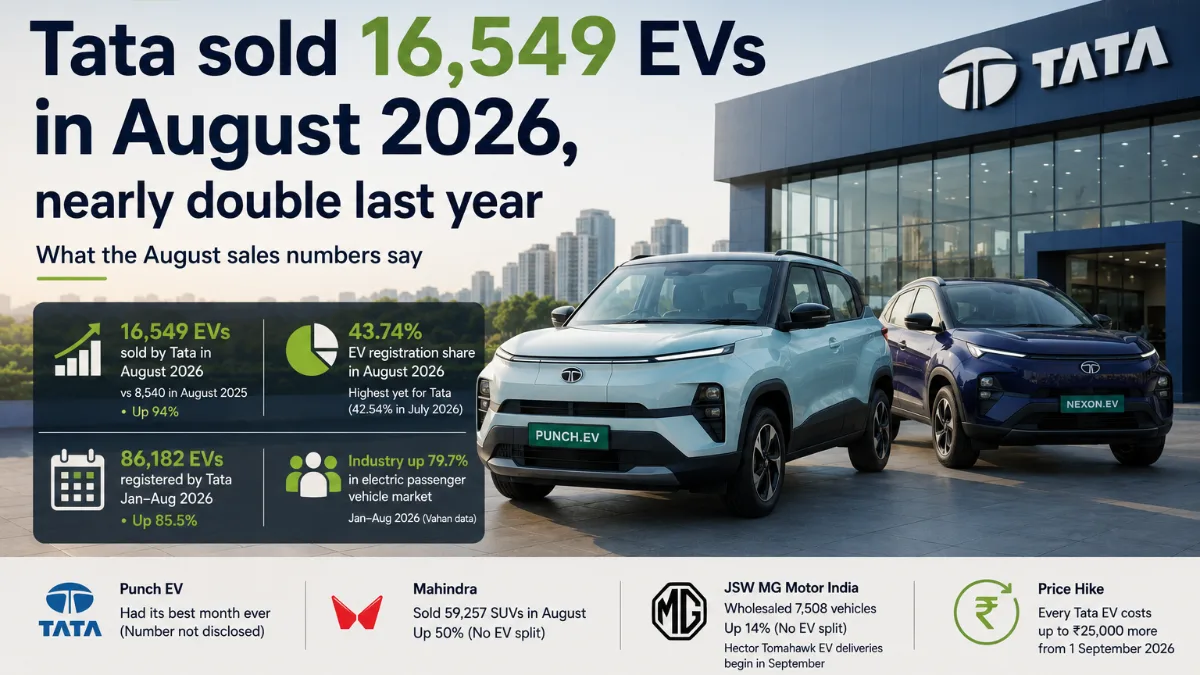
Tata Motors Passenger Vehicles sold 16,549 EVs in August 2026 across domestic and export markets, up 94% on 8,540 in August 2025 (Tata exchange disclosure, 1 September 2026).
Tata puts its August EV registration share at 43.74%, its highest yet, up from 42.54% in July (Tata release citing Vahan).
Across January to August 2026, Tata registered 86,182 EVs, up 85.5%, against a 79.7% expansion in the whole electric passenger vehicle market (Vahan data).
Mahindra sold 59,257 SUVs in India in August, up 50%, but does not split out EV volumes (Mahindra release).
JSW MG Motor India wholesaled 7,508 vehicles, up 14%, with no EV split published; Hector Tomahawk EV deliveries begin in September (JSW MG release).
Tata says the Punch EV had its best month ever but has not published the number (unconfirmed volume).
Every Tata EV costs up to ₹25,000 more from 1 September 2026 (Tata exchange filing, 21 August 2026).
Tata sold 16,549 EVs in August 2026, nearly double last year: what the August sales numbers say
Tata Motors Passenger Vehicles sold 16,549 electric cars in August 2026, against 8,540 in August 2025, a 94% rise that the company disclosed to the stock exchanges on 1 September 2026. It is the first month Tata's EV volume has crossed 16,500 units, and it lands three days before every Tata EV became up to ₹25,000 more expensive.
The headline is real but it needs two qualifiers before anyone reads it as market share. The 16,549 figure is a wholesale number, meaning cars dispatched to dealers and export partners, and it includes Tata's international business. Retail registrations, the number that says what buyers actually took home, come from the Vahan portal and are lower for every brand. We use both below and say which is which each time.
What Tata Has Confirmed
Tata's 1 September release puts total passenger vehicle sales at 67,753 units for August, up 56% on 43,315 a year earlier. Domestic wholesales were 65,253, up 59%, and exports hit an all-time monthly high of 2,500. On those numbers EVs were roughly one in four Tata cars sold in the month, up from about one in five in August 2025 (our calculation from the release).
Tata Motors PV, August 2026 | August 2026 | August 2025 | Change |
Total PV sales (domestic + exports) | 67,753 | 43,315 | +56% |
Domestic PV wholesales | 65,253 | 41,001 | +59% |
International business | 2,500 | 2,314 | +8% |
EV sales (domestic + exports) | 16,549 | 8,540 | +94% |
EV share of Tata's total (our calculation) | 24.4% | 19.7% | +4.7 points |
EV registration share (Tata, citing Vahan) | 43.74% | not stated | up from 42.54% in July |
Figures from Tata Motors Passenger Vehicles Ltd's sales disclosure to BSE and NSE under SEBI Regulation 30, 1 September 2026, accessed 2 September 2026. The two share rows are our arithmetic on those figures and Tata's own Vahan citation respectively.
Tata also says the Punch EV recorded its highest-ever monthly sales in August. It has not published the number, and it does not publish model-wise EV splits at all, so we cannot say how the Punch EV, Nexon EV, Curvv EV, Harrier EV and Sierra EV divided the 16,549 between them. That gap matters for buyers trying to read which models are gaining and which are being discounted to move.
Caveat Wholesale is not retail. The 16,549 is cars Tata invoiced to dealers and export partners in August, not cars registered by customers. Vahan registrations for the same month are typically several thousand lower and exclude exports. Tata's 43.74% share figure is a Vahan number; its 16,549 is a wholesale number; the two are not on the same base and should not be divided into each other. All Vahan figures also exclude Telangana, which is not on the Vahan 4 portal. |
What the Vahan Data Says
Registration data tells a longer story than one month. Across January to August 2026, Tata registered 86,182 electric cars, up 85.5% from 46,456 in the same eight months of 2025, according to Vahan data accessed on 1 September 2026. The whole electric passenger vehicle market grew 79.7% over the same period, so Tata grew slightly faster than the segment and its year-to-date EV share moved to 40.73% from 39.45%.
The monthly line is the more interesting one. Tata's EV share dropped to around 37.6% in March and April 2026, when the Mahindra BE 6 and XEV 9e were ramping and Maruti's e Vitara and VinFast had entered. It has since recovered to 42.54% in July and 43.74% in August. Two months of recovery is a trend; it is not yet proof that the spring dip was a blip rather than a ceiling.
EVs were 17.4% of Tata's own registrations in January to August, up from 12.9% a year earlier (Vahan). That is the number the demerged passenger vehicle company will be measured on, because every rival is chasing the same shift and most of them are starting from a lower base.
What Mahindra, MG, Kia and Hyundai Reported
None of the other four large sellers published an EV split for August, which is the single most useful thing missing from the day's releases. What they did publish is below.
Brand | August 2026 (company figure) | Change | EV split published? |
Mahindra | 59,257 domestic SUVs; 1,07,648 total including exports | +50% / +42% | No |
JSW MG Motor India | 7,508 wholesales, ICE and NEV combined | +14% | No |
Kia India | 29,042 wholesales, best-ever August | +48.1% | No |
Hyundai Motor India | 54,396 domestic, its highest August | +23.6% | No |
Maruti Suzuki | 1,80,078 domestic PV wholesales | +34.8% | No |
Figures from each company's August 2026 sales release, all dated 1 September 2026 and accessed 2 September 2026. NEV is JSW MG's term for its EV and plug-in hybrid models combined.
Mahindra's release names the BE 6 Sporteq launch and the extension of its Battery-as-a-Service plan to the XEV 9e and XEV 9S as August highlights, but attaches no volume to either. JSW MG says Hector Tomahawk EV deliveries start in September and the plug-in hybrid follows in November, so the Windsor EV remains the brand's only real EV volume line for now. Kia's 29,042 is an all-powertrain number and the Carens Clavis EV's contribution is not stated.
Until those brands publish EV splits, the Vahan portal is the only place a buyer can see their electric volumes, and it lags dispatches by a few days. We will publish the August registration table by brand once the month's data has settled, which usually takes until around the fifth of the following month.
What We Still Don't Know
Model-wise Tata EV volumes for August. Tata confirms a Punch EV record but publishes no number. Settled only if Tata discloses it, or once Vahan model-level data is compiled.
Mahindra, MG, Kia, Hyundai and Maruti EV volumes for August. None published a split. Vahan brand-level data, expected around 5 September 2026, is the fix.
How much of Tata's August wholesale was pre-festive dealer stocking ahead of the 1 September price rise. Tata does not report dealer inventory; the September retail number will show it.
The revised model-wise Tata EV price list. The exchange filing gives only the ₹25,000 ceiling.
Price and Rivals
The August numbers arrive one day after Tata raised prices across its ICE and EV range by up to ₹25,000, effective 1 September 2026, a revision it disclosed to the exchanges on 21 August. Hyundai has filed for an increase of up to 1% from September, and Maruti moved its prices in August. Anyone who bought a Tata EV between 25 and 31 August paid the old price, which is one reason a strong August wholesale should be read with some care.
For a buyer, the share numbers say less than the shelf. Tata's lead is built on the two cheapest mainstream EVs on sale, the Punch EV and Nexon EV, and on having seven electric nameplates against Mahindra's three. Our list of every electric car under ₹20 lakh is where that lead is decided, and it is where the e Vitara and BE 6 are aimed.
The ThatsmyEV Take
Tata is doing two things at once: stocking dealers hard before the festive season and before its own price rise, and letting a 94% headline do the talking while it says nothing about the model mix. Both are rational. Neither tells a buyer much. The number we would want, and the one no brand published on 1 September, is how many of each model went to real customers.
What decides the rest of 2026 is whether Tata's share holds above 40% in September and October, when the price rise has landed and the BE 6, XEV 9S, e Vitara and Hector Tomahawk EV are all in showrooms at the same time. The spring dip to 37.6% happened the last time rivals launched into Tata's space. Two good months since then is encouraging; four would be convincing.
If you are buying a Tata EV in September, the ₹25,000 is already on the invoice and no amount of August momentum brings it back, so negotiate on accessories and the charger rather than the ex-showroom figure. If you are choosing between a Nexon EV and a BE 6 in September, wait for the Vahan August table around 5 September before assuming Tata's wholesale strength means Tata is the safe pick; the registration data is what shows which car buyers are actually taking home.
Frequently Asked Questions
How many EVs did Tata Motors sell in August 2026?
Tata Motors Passenger Vehicles sold 16,549 electric cars in August 2026 across domestic and export markets, up 94% from 8,540 in August 2025, according to its exchange disclosure of 1 September 2026. The figure is wholesale, meaning cars dispatched to dealers and export partners, not customer registrations.
What is Tata Motors' EV market share in India in August 2026?
Tata puts its August 2026 electric car registration share at 43.74%, citing Vahan data in its 1 September 2026 release, up from 42.54% in July. Across January to August 2026 its share was 40.73% on Vahan registration data. Both are retail registration figures, not wholesale.
Which Tata EV sold the most in August 2026?
Tata has not published model-wise EV volumes for August 2026. Its release says the Punch EV recorded its highest-ever monthly sales, but attaches no number. The split between the Punch EV, Nexon EV, Curvv EV, Harrier EV and Sierra EV is therefore unconfirmed until Vahan model-level data is compiled.
How many EVs did Mahindra sell in August 2026?
Mahindra has not published an EV figure for August 2026. Its release reports 59,257 domestic SUVs, up 50% on August 2025, and 1,07,648 total vehicles including exports, with no split for the BE 6, XEV 9e and XEV 9S. Brand-level EV registrations will appear in Vahan data in early September 2026.
How many cars did MG sell in India in August 2026?
JSW MG Motor India reported wholesales of 7,508 units in August 2026, up 14% year on year, across its petrol, electric and plug-in hybrid models combined. It did not publish an EV split. The company says Hector Tomahawk EV deliveries begin in September 2026 and the plug-in hybrid follows in November.
What is the difference between wholesale sales and Vahan registrations?
Wholesale is the number of cars a manufacturer invoices to dealers and export partners in a month; Vahan registrations count cars actually registered by customers at RTOs. Wholesale is published on the first of the month by each company and includes exports. Vahan data lags by a few days, excludes Telangana, and is lower for every brand.
Did Tata EV prices increase in September 2026?
Yes. Tata Motors Passenger Vehicles raised prices across its ICE and EV range by up to ₹25,000 from 1 September 2026, per its exchange filing of 21 August 2026. The increase varies by model and variant and the revised model-wise EV price list had not been published as of 2 September 2026.
How fast is the electric car market in India growing in 2026?
Electric passenger vehicle registrations grew 79.7% in January to August 2026 compared with the same period of 2025, according to Vahan data accessed 1 September 2026. Tata's EV registrations grew 85.5% to 86,182 over the same eight months, slightly ahead of the segment.
Why did Tata EV sales nearly double in August 2026?
Two reasons are visible in the data. August 2025 was a weak base because buyers deferred purchases while waiting for a GST rate decision, and Tata's EV range has widened since then with the Curvv EV, Harrier EV and Sierra EV. Tata also raised prices from 1 September 2026, which typically pulls some dealer stocking into the prior month.
How many Tata EVs were registered in India in 2026 so far?
Tata registered 86,182 electric cars between January and August 2026, up 85.5% from 46,456 in the same period of 2025, according to Vahan data accessed 1 September 2026. EVs made up 17.4% of Tata's total registrations in that period, up from 12.9% a year earlier.
Ask a ThatsmyEV expert on WhatsApp which EV is right for you |
Sources: Tata Motors Passenger Vehicles Ltd sales disclosure to BSE and NSE under SEBI Regulation 30, 1 September 2026, and the accompanying press release, accessed 2 September 2026. Tata Motors Passenger Vehicles Ltd price revision disclosure, 21 August 2026. Mahindra & Mahindra, JSW MG Motor India, Kia India, Hyundai Motor India and Maruti Suzuki India August 2026 sales releases, all dated 1 September 2026. Vahan 4 portal registration data for January to August 2026, accessed 1 September 2026; Vahan excludes Telangana and the month is partial until a few days after month-end. Still open: model-wise EV volumes for every brand, which only Vahan model-level data will settle.
Comments
Write your comment on Tata sold 16,549 EVs in August 2026, nearly double last year: what the August sales numbers say
No comments yet. Be the first to share your thoughts.