Tata Nexon EV vs MG ZS EV (2026): The Most Detailed Comparison You'll Find
Quick Summary • Nexon EV starts at ₹12.49 lakh; ZS EV starts at ₹17.99 lakh, ₹5.5 lakh base price gap • ZS EV claims 461 km ARAI range on a single 50.3 kWh pack; Nexon EV offers 30 kWh and 45 kWh battery options with up to 489 km claimed range • ZS EV produces 174 hp and 280 Nm; Nexon EV produces 127 hp and 215 Nm • Nexon EV has a 5-star Global NCAP rating; ZS EV has not been crash tested in India • ZS EV wins on interior, ride quality, and range; Nexon EV on price, safety, and ground clearance
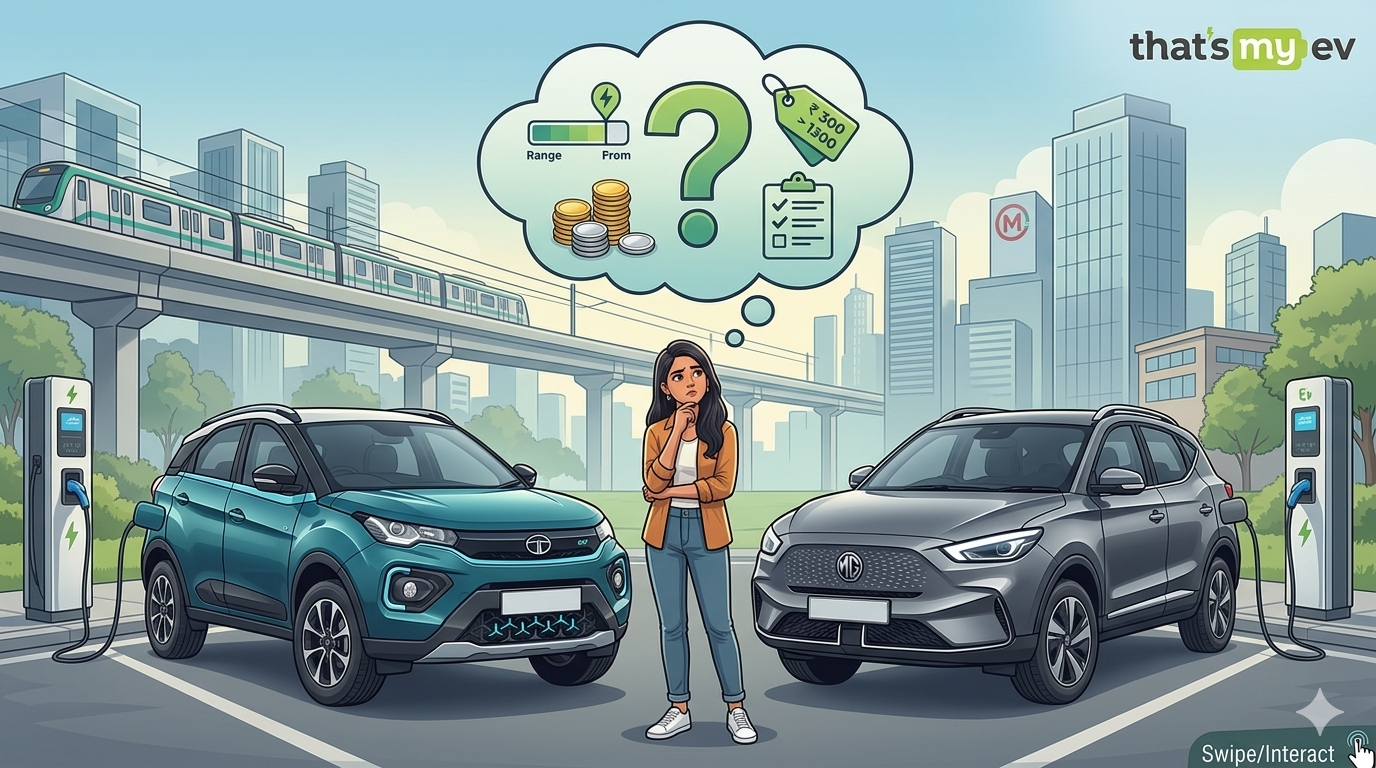
This is India's most searched EV comparison, and for good reason. Both cars have been bestsellers, both have earned genuine owner trust, and both sit in overlapping price territory. The Nexon EV starts at ₹12.49 lakh. The ZS EV starts at ₹17.99 lakh. That ₹5.5 lakh gap is real, but it doesn't automatically make the decision obvious.
Here's everything you need to know to pick the right one.
Price. The First Filter
MG ZS EV starts at ₹17.99 lakh and goes up to ₹20.50 lakh. Tata Nexon EV starts at ₹12.49 lakh. That's the base-to-base gap. Mid-spec to mid-spec, the ZS EV Exclusive sits around ₹19.5 lakh while the Nexon EV's well-equipped Creative+ Long Range is under ₹15 lakh.
That ₹5–6 lakh difference is the elephant in the room. For many buyers, it's the decision made. The Nexon EV delivers a complete, capable EV at a meaningfully lower price point. But if you're budget-flexible and want a more premium product, read on.
Battery & Range
The ZS EV has a single 50.3 kWh battery pack with a claimed range of 461 km. The Nexon EV offers two options: a 30 kWh base pack and a 45 kWh long-range pack with up to 489 km claimed range.
Real-world breakdown in Indian conditions:
Performance | Interior & Features | Dimensions & Space |
Nexon EV (30 kWh) | 30 kWh | 200–240 km |
Nexon EV (45 kWh) | 45 kWh | 300–340 km |
MG ZS EV | 50.3 kWh | 300–350 km |
The ZS EV's range advantage over the base Nexon EV is real. Against the 45 kWh Nexon EV, it's broadly comparable. The ZS EV has a slight edge on highway runs, while the Nexon EV's 45 kWh variant matches it in city driving.
Safety
The ZS EV produces 174 hp and 280 Nm; the Nexon EV produces 127 hp and 215 Nm. That's a noticeable difference; the ZS EV feels punchier on highway merges and quicker during overtaking manoeuvres. In city stop-start traffic, both feel adequately quick thanks to instant electric torque.
The ZS EV also has a smoother, more refined ride quality. It offers a smoother drive experience that's more new EV buyer-friendly, particularly on well-laid city roads. The Nexon EV, with its higher ground clearance of 205 mm vs the ZS EV's 177 mm, is the better choice for broken roads, speed bumps, and occasional off-tarmac use.
Service Network: Nexon EV Wins Clearly
This is where the ZS EV justifies a chunk of its premium. The ZS EV has rich interior quality that feels very upmarket, with a good features list including a 10.1-inch touchscreen and digital instrument cluster, and a realistically achievable range of 300–350 km on a full charge.
The Nexon EV's updated cabin is no slouch; it's loaded with features including a larger 12.3-inch touchscreen, digital driver's display, and vehicle-to-load charging on higher variants. The JBL (Harman) sound system, panoramic sunroof, ventilated front seats, and 360-degree camera on top trims are genuinely competitive.
Where the ZS EV feels more premium: seat quality, dashboard material texture, and overall cabin refinement. It doesn't have the feature list advantage over the Nexon EV. The Tata has more tech on paper, but the execution and material feel are a step above.
The Nexon EV's V2L (vehicle to load) charging is a practical differentiator. You can power appliances directly from the car, useful during power cuts or camping. The ZS EV doesn't offer this.
Head-to-Head Summary
The ZS EV is 4,323 mm long with 488 litres of boot space and 177 mm ground clearance. The Nexon EV is 3,994 mm long with 350 litres of boot space and 205 mm ground clearance.
The ZS EV is meaningfully larger. Both in the cabin space and the boot. However, rear seat legroom in the ZS EV is a known limitation; multiple owners report it being tight for taller passengers, with rear ingress and egress being inconvenient for shorter or older family members. Despite its larger exterior, the ZS EV's rear cabin doesn't automatically translate to a better passenger experience.
The Nexon EV's compact dimensions (sub-4 metre) also mean lower road tax in most Indian states, a real on-road cost saving.
Who Should Buy Which
The Nexon EV has a 5-star Global NCAP safety rating. One of the highest for any Indian EV. Both cars offer 6 airbags as standard across comparable variants. The ZS EV hasn't been independently crash tested in India, which is a genuine gap for safety-conscious buyers.
Tata's service network is one of the deepest in India. Over 1,000 authorised service centres including in Tier-2 and Tier-3 cities. MG has a smaller, more metro-concentrated network. If you live outside the top 10–15 cities, Tata's after-sales reach is a practical, daily-life advantage.
Starting Price | ₹12.49L | ₹17.99L |
Battery Options | 30 / 45 kWh | 50.3 kWh |
Real-World Range (LR) | 300–340 km | 300–350 km |
Motor Power | 127 hp / 215 Nm | 174 hp / 280 Nm |
Ground Clearance | 205 mm | 177 mm |
Boot Space | 350L | 488L |
NCAP Rating | 5-Star | Not tested |
V2L Charging | Yes | No |
Interior Feel | Feature-rich | More premium |
Service Network | Wider | Metro-focused |
Buy Nexon EV if: Budget is ₹12–16 lakh, safety rating matters, you live outside a major metro, you need higher ground clearance, or you want V2L charging.
Buy ZS EV if: Budget allows ₹18–21 lakh, premium interior feel is a priority, you want a larger cabin and more power, and you're in a metro where MG's service network is adequate.
Tata Nexon EV price and range • MG ZS EV full specifications • compare EV cars side by side
FAQs
Comments
Write your comment on Tata Nexon EV vs MG ZS EV (2026): The Most Detailed Comparison You'll Find
No comments yet. Be the first to share your thoughts.