BYD Seal vs Tesla Model 3 in India (2026): Which Premium EV Should You Buy?
Quick Summary • BYD Seal starts at ₹41 lakh; Tesla Model 3 starts at ₹60 lakh, a ₹19 lakh gap at base level • Tesla Model 3 makes more power at 460 hp vs BYD Seal's 308 hp • Tesla wins on range and charging speed; BYD Seal wins on interior comfort, physical controls, and value • Tesla has no Supercharger network in India yet, the charging infrastructure advantage doesn't transfer • BYD Seal has Blade Battery LFP technology: better suited to Indian heat than Tesla's NMC chemistry
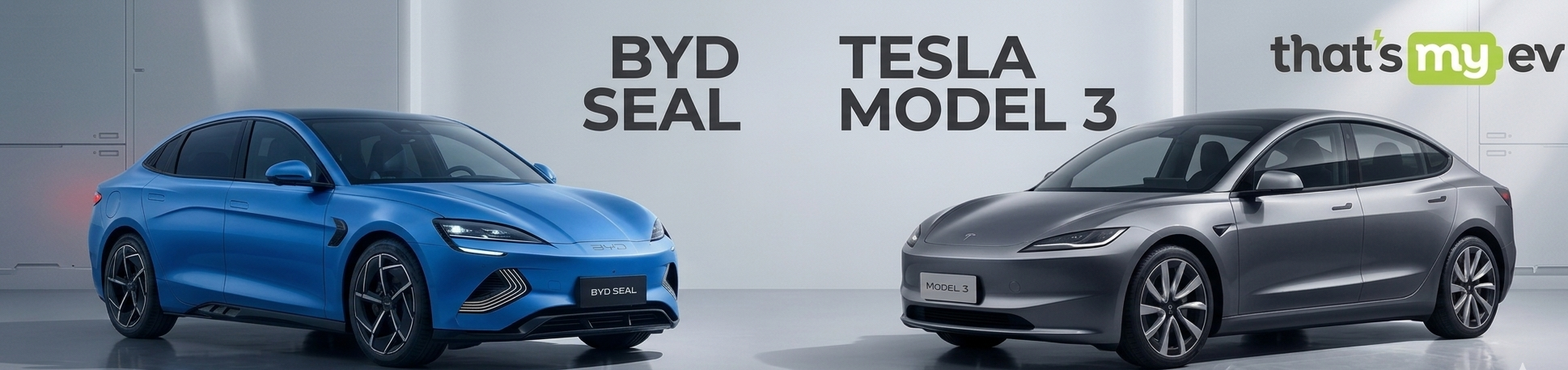
Two sedans. Two very different companies. One is the brand that redefined what a premium electric car looks like. The other is the brand that's been quietly outselling it globally for the past two years. In India, both are available at a price gap that makes the decision genuinely interesting.
Here's the honest comparison, with the Indian context front and centre.
Price: The Elephant in the Room
The BYD Seal starts at ₹41 lakh for the Dynamic variant and goes up to ₹53 lakh for the Performance variant. The Tesla Model 3 starts at ₹60 lakh and goes up to ₹70 lakh.
That's not a minor gap. It's ₹19 lakh at the base level. In India, where Tesla arrives as a CBU import without local manufacturing and carries significant import duties baked into the price, the Model 3's premium over the Seal is substantially wider than in global markets. In the UK, for instance, the Model 3 is actually cheaper than the Seal. In India, it's the opposite and by a large margin.
For that ₹19 lakh premium, you need to be very clear about what you're actually getting.
Performance & Range
The Tesla Model 3 has power of 460 hp with 660 Nm torque; the BYD Seal produces 308 hp with 360 Nm torque, making the Model 3 significantly more powerful.
On the road, that difference is felt. Tesla drives like a go-kart. Sharp steering, precise handling, and point-and-squirt acceleration make it genuinely engaging on a winding road. The BYD Seal offers smoother power delivery, a more relaxed ride, and superior comfort on broken surfaces, better suited to daily use on Indian roads.
On range, the Tesla Model 3 Long Range claims 421 miles WLTP vs the BYD Seal's 323 miles. Tesla has a clear advantage in real-world highway efficiency. In the Indian context, Tesla's efficiency edge is real, but the Seal's real-world range of 400 to 420 km is perfectly adequate for even long-distance Indian driving.
The India-Specific Charging Problem for Tesla
This is where the global comparison breaks down completely when applied to India.
Tesla's biggest real-world advantage worldwide is its Supercharger network. Proprietary fast chargers placed strategically on highways, optimised for Tesla vehicles, and available in almost every market Tesla sells in. Tesla peaks at 250 kW DC charging via the reliable Supercharger network, optimised for speed and availability worldwide.
In India, Tesla has no Supercharger network. None. The Model 3 in India charges on the same public CCS2 chargers as every other EV, the same ones BYD uses. That single biggest Tesla advantage disappears entirely on Indian roads. You're left with a very expensive car whose charging infrastructure advantage is theoretical, not practical.
The BYD Seal, meanwhile, uses the growing CCS2 public DC network in India, the same infrastructure everyone else relies on, which is expanding rapidly.
Interior & Features: BYD Wins
The Tesla Model 3's cabin is ultra-minimalist. A 15-inch touchscreen controls virtually everything, including climate, with no physical buttons. Clean design, but adjusting the AC temperature while driving requires navigating a touchscreen menu. There's also no Apple CarPlay or Android Auto, a significant omission at this price.
The BYD Seal has a curvy dashboard, physical stalks, a drive selector, a digital driver's display, and a head-up display, all absent in the Tesla. Material quality is comparable. The touchscreen isn't quite as sharp as Tesla's, but the overall usability for an Indian buyer is meaningfully better.
BYD Seal buyers also get heated and ventilated front seats, a head-up display, and power-folding mirrors as standard, features that the equivalent Tesla trim doesn't include.
The BYD Seal has a boot space of 400 litres; the Tesla Model 3 offers 594 litres. A meaningful difference if you regularly carry luggage or use the car for family trips.
Battery Technology: India Climate Factor
BYD's Blade Battery uses LFP (Lithium Iron Phosphate) chemistry. Built on BYD's e-Platform 3.0 with the proven Blade Battery, the Seal delivers consistent real-world range and BYD's growing reputation for battery durability and safety.
LFP handles heat better than NMC chemistry, important in India, where summer temperatures regularly cross 45°C in cities like Delhi and Nagpur. The Blade Battery's cell-to-body integration also makes it structurally part of the chassis, increasing torsional rigidity and lowering the floor by 150mm for a sportier centre of gravity.
Tesla's Model 3 uses NMC chemistry. Higher energy density, better range, but slightly more heat-sensitive. In Indian conditions, this is a real consideration for long-term battery health.
Head-to-Head Comparison
Service Network: Both Are Weak, But Tesla More So | Verdict | |
Starting Price (India) | ₹41L | ₹60L |
Motor Power | 308 hp / 360 Nm | 460 hp / 660 Nm |
Real-World Range | 380–420 km | 450–490 km |
0 to 100 km/h | ~5.9 sec | ~4.4 sec (LR AWD) |
Boot Space | 400L | 594L |
Head-Up Display | Yes | No |
Apple CarPlay/Android Auto | No | No |
Physical Controls | Yes | Minimal |
Fast Charging (India) | CCS2 public | CCS2 public (no Supercharger) |
Battery Chemistry | LFP (Blade) | NMC |
Service Network India | Limited (metro only) | Very limited |
Neither brand has a wide service network in India. BYD has under 200 authorised touchpoints. Tesla's India service presence is even more nascent, currently limited to a handful of service centres in major metros.
For buyers outside Delhi, Mumbai, or Bengaluru, this matters significantly. If your EV needs a non-routine repair, wait times and logistics can be a real problem with either brand.
Choose BYD Seal for better interior, physical controls, and superior value at ₹41 lakh. Choose the Tesla Model 3 if charging network and software matter most to you. But know that the Supercharger network advantage doesn't exist in India yet.
The honest India verdict: at ₹19 lakh less, the BYD Seal is the rational choice for most buyers in this segment. The Tesla is a better driver's car, but in Indian traffic, on Indian roads, with India's current charging infrastructure, that advantage rarely shows up in daily life. The BYD's Blade Battery, better interior usability, and ₹19 lakh of savings are felt every single day.
If you're spending ₹60L on an electric sedan in India in 2026, the Kia EV6 at a similar price with a proper ADAS suite and 800V charging capability is arguably a stronger pick than either.
FAQs
Comments
Write your comment on BYD Seal vs Tesla Model 3 in India (2026): Which Premium EV Should You Buy?
No comments yet. Be the first to share your thoughts.