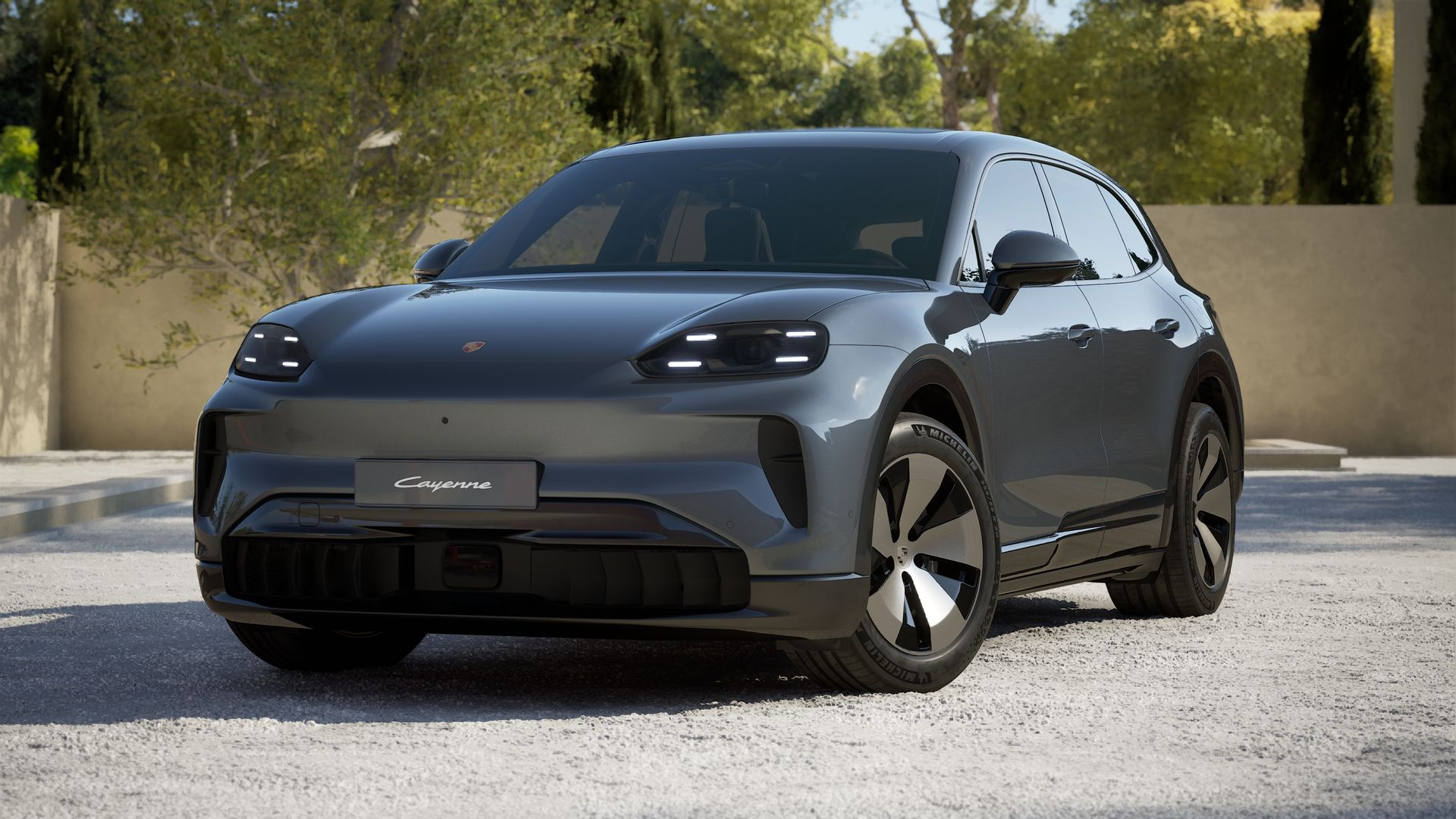
Porsche Cayenne Electric review by ThatsmyEV team
The hardest-accelerating and fastest-charging SUV India can buy, built by the company that has the most to lose by getting an electric SUV wrong.
Our Take
The precedent. When the first Cayenne arrived in 2002, the reaction from Porsche loyalists ranged from disappointment to open hostility. It went on to sell 276,652 units in its first generation alone and paid for the sports cars those loyalists wanted. The electric Cayenne is the same bet in a different currency. It does not replace the petrol Cayenne, which continues in India from ₹1.39 crore, and it does not try to be a quiet luxury liner in the Mercedes-Benz EQS SUV mould. It is an SUV that happens to hold the most powerful drivetrain Porsche has ever put in a production car.
Battery
The numbers. Both variants share one 113 kWh gross nickel-rich lithium-ion battery on the 800-volt Premium Platform Electric architecture that Porsche co-developed with Audi and also uses under the Macan Electric and Audi Q6 e-tron. Porsche does not publish a usable figure, which is worth noting when you compare it with rivals that do. Certified driving range is 642 km WLTP for the Cayenne Electric and 623 km WLTP for the Cayenne Turbo Electric, the difference coming from the Turbo's staggered 21-inch tyres and extra mass.
Charging
The headline. 390 kW peak DC charging, rising to 400 kW under specific conditions, 10 to 80 percent in 16 minutes, and up to 325 km of WLTP driving range added in ten minutes. No other car sold in India charges faster. The EQS SUV 580 4MATIC peaks at 200 kW, the BMW iX at about 195 kW, and the Grecale Folgore at 150 kW because it is still a 400-volt car. The Lotus Eletre R is the only genuine 800-volt rival at 350 kW, and it still needs 20 minutes for the same 10 to 80 percent window.
Driving feel
The transmission call. The Taycan and the Macan Electric use a two-speed gearbox on the rear axle. The Cayenne Electric does not, and that is a decision rather than a cost saving. Porsche uses a two-stage single-speed transmission on both axles, arguing that the new motors have a wide enough spread of performance and efficiency that a second ratio is dead weight. The result is a lighter, more compact drive unit that is now mounted to the rear subframe rather than hard to the body, which is a change made purely for ride comfort. Note that some circulating Indian specification sheets still list a two-speed rear axle for this car; Porsche's own technical documentation for the Cayenne Electric does not.
Safety
Passive safety. Eight airbags are standard on both variants, covering dual front, front side, rear side and full-length curtain, with rollover detection that triggers the curtain airbags and the seat belt pretensioners. A multi-collision brake system is standard, as is Porsche Stability Management with ABS, anti-slip regulation, automatic brake differential and trailer stability management. The bodyshell is a fully galvanised steel and aluminium hybrid with high-strength cross members and dedicated deformation elements in both bumpers.
Interior and technology
The display architecture. The centrepiece is the curved Flow Display, the largest screen ever fitted to a Porsche, which sweeps from the dashboard down into the centre console. Behind the wheel sits a 14.25-inch curved OLED instrument cluster, and there is an optional 14.9-inch passenger display that will stream video on the move without being visible to the driver. The augmented reality head-up display projects navigation arrows into the road ahead with an effective image size of 87 inches. A note on sources: some India specification sheets list a 12.6-inch cluster and a 10.9-inch centre screen, which are the previous-generation Porsche Communication Management sizes; Porsche's own launch material for this car confirms the larger curved units.
The verdict
Strip away the badge and the Cayenne Electric is the most technically convincing electric SUV on sale in India. Nothing else here charges at 390 kW, recovers energy at 600 kW, or extracts 642 km of WLTP driving range from a 113 kWh battery while weighing 2,525 kg. The Turbo's 1,156 PS is a headline, but the base car's efficiency is the real achievement, and the double-sided battery cooling and direct oil-cooled motors are the kind of engineering that shows up in year five of ownership rather than in the first test drive.
ThatsmyEV Rating
Score: 4.17 / 5