CAFE III notified: EVs count three times from April 2027, and that will show up in prices
Quick Summary
The Ministry of Power notified CAFE III on 29 September 2026; it applies to cars built from 1 April 2027 to 31 March 2032.
Battery-electric and range-extender EVs get a 3.0 super-credit; plug-in hybrids and flex-fuel strong hybrids get 2.5.
Credits can be traded or pooled; BEE sells credits at ₹2,500 per g CO₂/km in FY2027-28, rising to ₹4,500 by FY2031-32.
No dedicated small-car concession; makers under 1,000 cars a year are exempt from targets.
Nothing changes for cars bought in October 2026; expect the effect on EV pricing from FY2027-28.
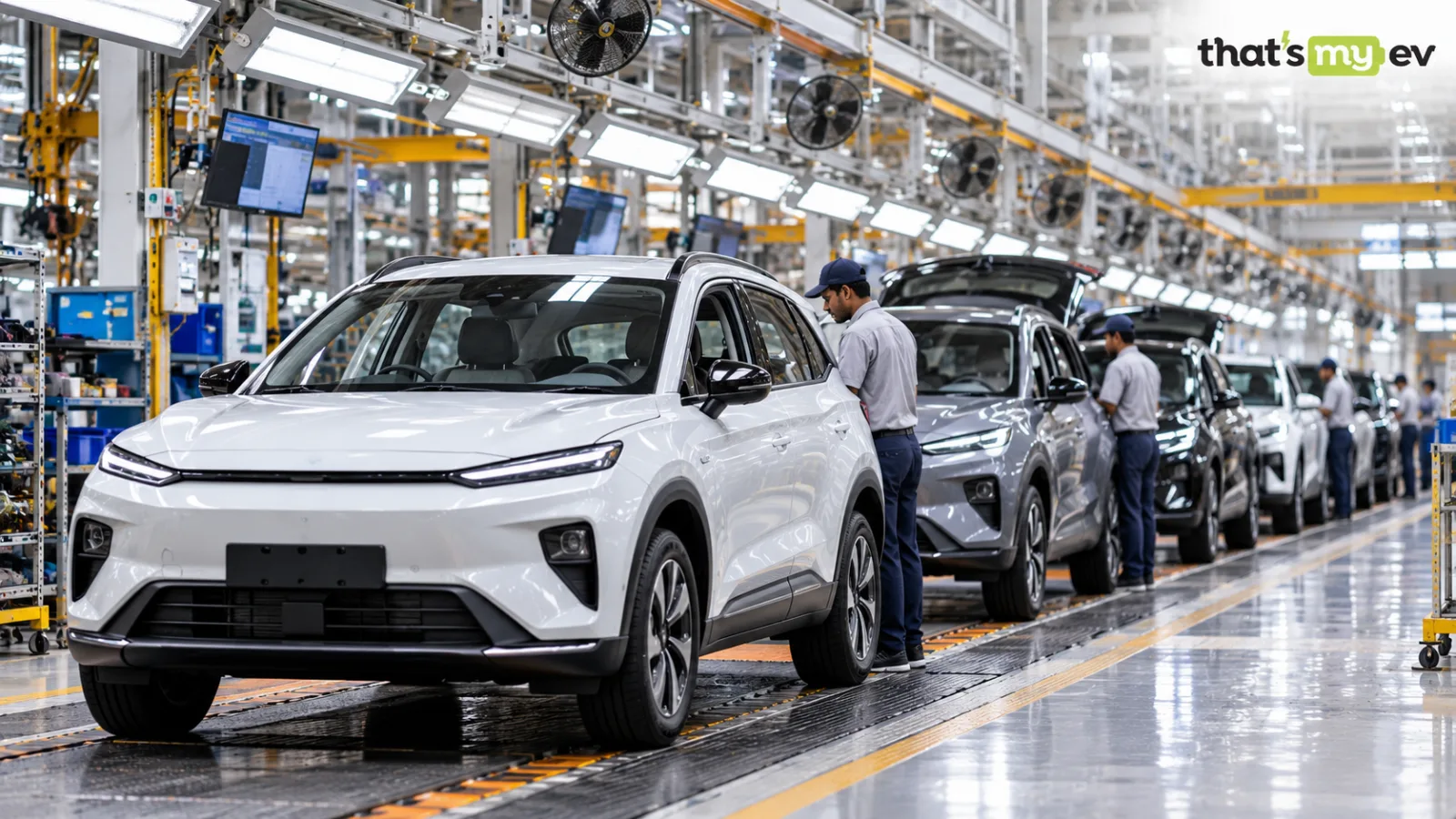
CAFE III notified: EVs count three times from April 2027, and that will show up in prices
The Ministry of Power notified India's third Corporate Average Fuel Economy rules on 29 September 2026, and every battery-electric car sold from 1 April 2027 will count as three cars when a carmaker's fleet average is worked out. That single multiplier is the most consequential EV policy change of the year for anyone shopping for an electric car between now and 2032, because it turns each EV a company sells into compliance value it can spend, bank or trade. If you are comparing cars, start with our full list of electric cars on sale in India.
CAFE III does not order anyone to build EVs. It sets a fuel-consumption ceiling for each manufacturer's whole passenger-car fleet and lets the company choose how to get under it. What changed between the July draft and the final text is less than the industry lobbied for, and the small-car carve-out several makers asked for is not in it.
What the Ministry of Power has confirmed
The notification covers M1 vehicles, meaning cars, SUVs and MPVs with up to eight passenger seats plus the driver, manufactured or imported for sale in India. It applies from 1 April 2027 and lapses after 31 March 2032. The ministry released a draft on 16 July 2026 and took comments until 6 August, so the final rules arrived about seven weeks after consultation closed.
Item | CAFE III, as notified |
Notified by | Ministry of Power, 29 September 2026 |
In force | 1 April 2027 to 31 March 2032 |
Vehicles covered | M1 passenger vehicles, made or imported for sale |
How the target is set | Per manufacturer, from the weighted average unladen mass of its fleet |
Super-credit, BEV and range-extender EV | 3.0 |
Super-credit, plug-in hybrid and flex-fuel strong hybrid | 2.5 |
Compliance blocks | Two: FY2027-28 to FY2029-30, then FY2030-31 to FY2031-32 |
Credits | Recorded in a passbook; tradeable and poolable between makers |
Buying credits from BEE | ₹2,500 per g CO₂/km in FY2027-28, rising to ₹4,500 by FY2031-32 |
Small-volume exemption | Fewer than 1,000 eligible vehicles a year: no target, reporting still required |
Dedicated small-car concession | Not included |
Figures from the Ministry of Power CAFE III notification dated 29 September 2026 and the ministry's draft of 16 July 2026, both accessed 8 October 2026.
How the 3x super-credit works
Each manufacturer gets a fleet target worked out from how heavy its cars are on average, so a maker of large SUVs gets a looser ceiling than a maker of small hatchbacks, but both have to improve every year. Actual consumption is measured on the Indian MIDC test cycle and converted to petrol-equivalent litres per 100km. The ministry states that an EV's contribution is weighted by a multiplier of 3.0 when the fleet average is calculated, which pulls the average down far harder than its own zero-litre figure would.
In plain arithmetic, a company selling 97 petrol cars and 3 EVs is assessed as though EVs made up about 8 percent of its fleet rather than 3 percent. That is our illustration of the weighting, not a figure the ministry publishes, but it shows why a few thousand extra EV registrations a year can matter more to a carmaker's compliance than shaving a tenth of a litre off every petrol engine.
MIDC now, WLTP later CAFE III measures fuel use on the Indian MIDC cycle. The July draft said a conversion factor between MIDC and WLTP would be notified separately, and the ministry has not published one. Do not compare a CAFE target with a WLTP brochure figure: the cycles do not convert by a fixed ratio, which is why ThatsMyEV never applies one. Our range cycles explainer covers the gap. |
Who has to change most
Makers whose fleets are mostly light petrol cars lose the most from the missing small-car concession, because their mass-based target is already tight and their fastest route down is adding EVs, strong hybrids or CNG. Makers with heavy EV volume, Tata, Mahindra and JSW MG on the September registration data in our EV sales tracker, start with surplus they can sell. The notification lets credits move between companies, so for the first time an EV sold in India can earn money for its maker twice: once at the showroom and once as a credit sold to a rival that is short.
The BEE buy-out price sets the ceiling on what those credits are worth. A carmaker short of its target can buy compliance from the Bureau of Energy Efficiency at ₹2,500 per gram of CO₂ per km in FY2027-28, rising each year to ₹4,500 in FY2031-32, according to the notification. No rival will pay another maker more than that, so the BEE price is effectively the market cap.
Shortlisting an EV before the festive rush? Get a free expert callback |
What it means for buyers in the next 18 months
Nothing in CAFE III changes the price of a car on sale on 8 October 2026. The rules bite on vehicles built from 1 April 2027, and the first compliance block runs three years, so a maker can be behind in FY2027-28 and catch up by FY2029-30. Expect the pressure to show up as EV pricing and as new EV launches from brands that have none, rather than as a sudden cut on 1 April. Our guide to EVs by price will track the moves as they land.
The second effect is on petrol cars. Every heavy petrol SUV a company sells raises its fleet average, so a maker with a weak EV line-up has a reason to price its EVs more aggressively and, at the margin, to stop discounting its thirstiest petrol models. Neither the Ministry of Power nor any carmaker has said that is the plan; it is the incentive the rule creates.
The ThatsmyEV Take
We read CAFE III as a pricing rule disguised as an efficiency rule. The 3.0 multiplier makes an EV worth three times its volume on the compliance ledger, and credit trading lets the companies that already sell EVs in volume charge everyone else for that. The losers are makers that bet on small petrol cars and asked for a carve-out they did not get.
What decides whether it works is the credit price. If too many makers can pool or buy their way to compliance at the BEE rate, the 3x incentive becomes a line item rather than a reason to build EVs. The first real test is the FY2027-28 passbook, and BEE has not said whether it will publish manufacturer-level positions.
For a buyer on 8 October 2026: do not delay a Navratri purchase to wait for CAFE III. If your purchase can slip to the second half of 2027, expect sharper EV offers from brands whose fleets are heavy on large petrol SUVs, because they will be the ones paying for credits. ThatsMyEV will flag those offers as they appear.
Frequently Asked Questions
What is CAFE III in India?
CAFE III is the Ministry of Power's fuel-economy rule for passenger cars, notified on 29 September 2026. It sets a fleet-average fuel-consumption target for each carmaker from 1 April 2027 to 31 March 2032, calculated from the weighted average weight of the cars it sells.
When do CAFE III norms come into force?
CAFE III applies to M1 passenger vehicles manufactured or imported for sale from 1 April 2027 and lapses after 31 March 2032. Compliance is assessed in two blocks: three years from FY2027-28, then two years from FY2030-31.
How much credit do EVs get under CAFE III?
Battery-electric and range-extended electric cars get a super-credit multiplier of 3.0 under the notification, the highest of any powertrain. Plug-in hybrids and flex-fuel strong hybrids get 2.5. The multiplier applies when a maker's fleet average is calculated.
Does CAFE III make EVs mandatory?
No. CAFE III sets a fleet fuel-consumption ceiling and lets each carmaker choose how to meet it, through EVs, hybrids, CNG, efficiency technology, pooled credits or credits bought from the Bureau of Energy Efficiency. There is no EV sales quota in the notification.
Is there a small car exemption in CAFE III?
No dedicated small-car concession appears in the final CAFE III notification of 29 September 2026. Manufacturers selling fewer than 1,000 eligible vehicles a year are exempt from the target but must still report fuel-consumption data.
Can carmakers trade CAFE III credits?
Yes. CAFE III records credits and debits in a passbook and allows them to be traded or pooled between manufacturers. A maker short of its target can also buy credits from BEE at ₹2,500 per g CO₂/km in FY2027-28, rising to ₹4,500 by FY2031-32.
Will CAFE III make electric cars cheaper?
CAFE III does not cut any EV price directly, and no carmaker has announced a price change linked to it. It gives makers a strong incentive to sell more EVs from April 2027, which typically shows up as sharper pricing and more launches.
Which test cycle does CAFE III use?
CAFE III measures fuel consumption on the Indian MIDC cycle, converted to petrol-equivalent litres per 100km. The ministry's July 2026 draft said a conversion factor between MIDC and WLTP would be notified separately; it has not been published.
Should I wait for CAFE III before buying an EV?
Not for a purchase in October or November 2026, because the rules only apply to cars built from 1 April 2027. Buyers who can wait until the second half of 2027 may see stronger EV offers from brands that need credits.
Want a second opinion on which EV to book this Navratri? Ask a ThatsmyEV expert on WhatsApp |
For how MIDC, WLTP and EPA range figures differ, read our range test cycles explainer, and for the basics of how EV incentives stack, our Learn hub.
Sources
Ministry of Power, Corporate Average Fuel Economy norms for M1 category motor vehicles 2027 to 2032, notification dated 29 September 2026; Ministry of Power draft CAFE 2027 notification dated 16 July 2026, published on powermin.gov.in; both accessed 8 October 2026. The 97-to-3 fleet example is our own illustration.
Comments
Write your comment on CAFE III notified: EVs count three times from April 2027, and that will show up in prices
No comments yet. Be the first to share your thoughts.