Tata Tiago EV vs Citroen eC3 (2026): Best Budget Electric Hatchback?
Quick Summary
• Tiago EV starts at ₹7.99L; eC3 starts at ₹11.50L. ₹3.5L base difference, narrowing to ₹2.5L at comparable specs
• eC3 is physically larger: 3,981 mm vs 3,769 mm; 315L boot vs 240L; higher ground clearance (170 mm vs 165 mm)
• Tiago EV is more feature-rich: automatic climate control, cruise control, projector headlamps, reversing camera, leatherette upholstery, and an 8-speaker Harman sound system
• eC3 motor makes 57 hp and 143 Nm from a 29.2 kWh battery; Tiago EV makes 74 hp and 114 Nm from a 24 kWh battery on the Long Range variant
• Tiago EV hits 120 km/h top speed vs eC3's 107 km/h limit
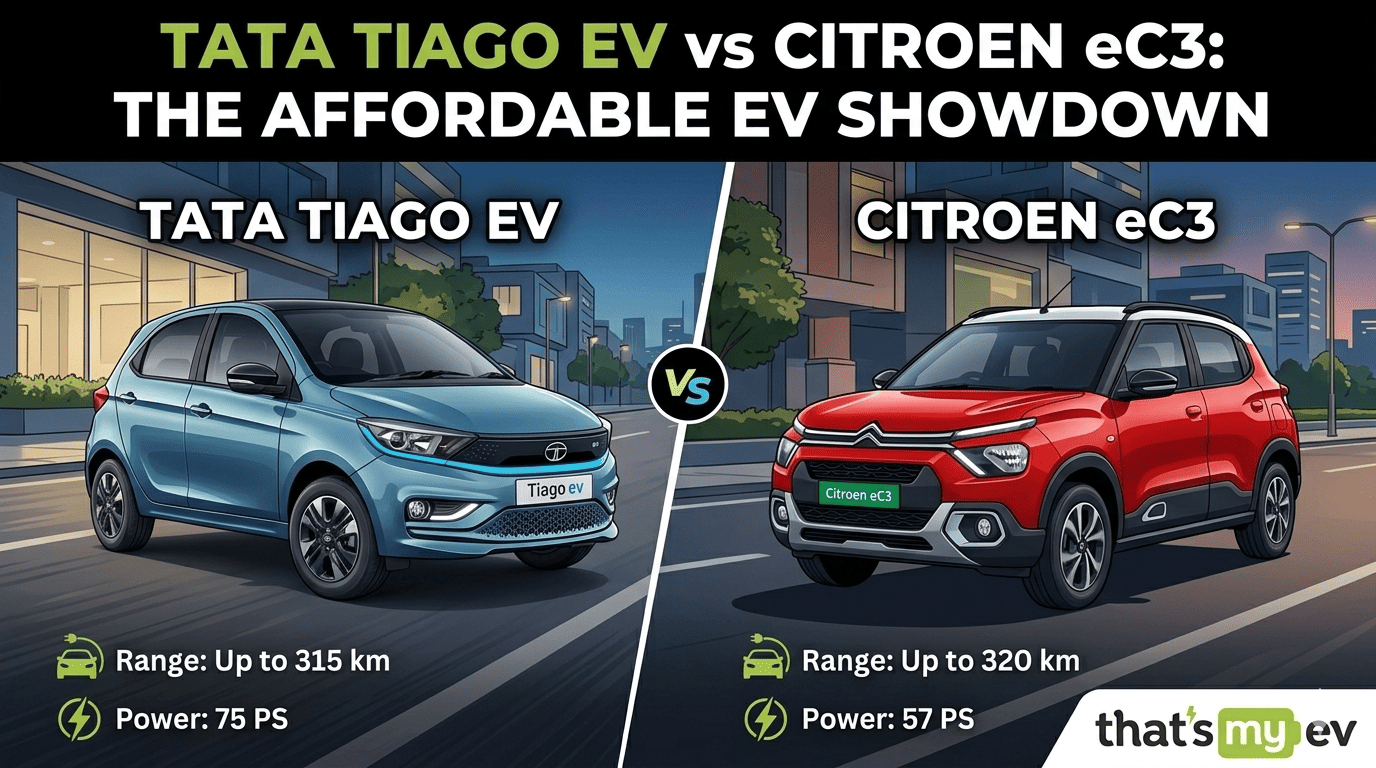
India's budget EV hatchback segment has exactly two serious contenders. The Tata Tiago EV at ₹7.99 lakh, the most affordable EV from the most trusted EV brand in India. The Citroen eC3 starting at ₹11.50 lakh, a European-styled option that prioritises space and practicality over features and price.
The gap between them is almost ₹4 lakh at base. What does that gap actually buy you?
Price
The base price of Citroen eC3 is ₹11.50 lakh and the top model is ₹13.41 lakh. The Tata Tiago EV starts at ₹7.99 lakh and goes up to ₹11.49 lakh for the XZ Plus Fast Charge variant.
At the top spec, these two sit within ₹2 lakh of each other. At base, the Tiago EV is ₹3.5 lakh cheaper. For a first-time EV buyer, that price difference is significant. It's the difference between stretching your budget and buying comfortably.
Design & Space
The eC3 has an SUV-like stance due to its upright presence, body cladding and roof rails give it a rugged look. But it looks nearly identical to the petrol C3, with flap-style door handles and fender-mounted indicators giving it a somewhat dated feel. It carries the design of its ICE sibling without differentiation.
The Tiago EV, by contrast, has distinct blue accents, projector headlamps, and turn indicators on the ORVMs, clearly an EV with a distinct identity. Passive entry and push-button start add a premium feel the eC3 top spec lacks.
The eC3 is 3,981 mm long with 315 litres of boot space; the Tiago EV is 3,769 mm long with 240 litres of boot space. The eC3 wins meaningfully on space. With 75 litres more boot is noticeable on a weekend trip with luggage. The eC3 also packs a spare tyre beneath the boot floor; the Tiago EV makes do with an inflator kit.
Interior & Features
The Tiago EV features automatic climate control, automatic projector headlamps, cruise control, electric folding mirrors, a reversing camera, rear wiper and washer, leatherette upholstery, and a Harman 8-speaker sound system.
The eC3 gets a larger 10.2-inch touchscreen, nicer than the Tiago's 7-inch unit but misses out on adjustable regen braking modes, powered mirror adjustment, auto AC, passive keyless entry, and push-button start. The Tiago EV wins on feature count despite the price gap.
The Tiago EV's seats are nice though not as comfy as the eC3's, and its rear cabin is tighter, because the batteries are positioned to keep the floor height unchanged, the seating position feels more natural than the eC3 despite less total space. The eC3's raised floor due to battery positioning results in a knees-up position with almost no thigh support for tall occupants.
Performance
The Tiago EV feels more responsive and eager than the Citroen even in City mode, torque response is crisper. The eC3's motor delivers performance in an unhurried manner; first-time EV users find little to complain about, but there's no zippy acceleration synonymous with modern EVs. Mild vibrations at low speeds also affect eC3's refinement.
The Tiago EV has two drive modes: City (75% torque) and Sport (full output). This flexibility, combined with adjustable regen levels, makes it a more engaging and tuneable daily driver.
Range
The Tiago EV 24 kWh variant delivers approximately 150–200 km of real-world range. The eC3's 29.2 kWh battery delivers approximately 170–220 km in mixed conditions. Real-world difference: 20–30 km in eC3's favour, meaningful but not decisive for typical city use patterns.
Neither car has DC fast charging on lower variants. The Tiago EV's top-spec XZ Plus Fast Charge supports DC, while the eC3 has no DC charging option at all. For daily home-charge use, both are adequate. For occasional long runs requiring a top-up stop. The Tiago EV's DC capability on top spec is a genuine advantage.
Service Network
Tata's pan-India service network is among the deepest in the country with over 1,000+ EV-capable centres across metros, Tier-2, and Tier-3 cities. Citroen's network is significantly smaller and more metro-concentrated. For buyers outside the top 10 cities, this is a real, daily-life consideration.
Head-to-Head
Feature | Tata Tiago EV | Citroen eC3 |
Starting Price | ₹7.99L | ₹11.50L |
Battery | 19.2/24 kWh | 29.2 kWh |
Real-World Range | 150–200 km | 170–220 km |
Motor Power | 74 hp / 114 Nm | 57 hp / 143 Nm |
Top Speed | 120 km/h | 107 km/h |
Boot Space | 240L | 315L |
DC Fast Charging | Top spec only | No |
Auto Climate Control | Yes | No |
Harman Sound System | Yes | No |
Passive Entry | Yes | No |
Service Network | Wide | Metro-focused |
Verdict
The eC3 is for those whose primary focus is space and ground clearance; those who want a premium cabin experience, fun-to-drive element, and better value overall should go with the Tiago EV.
At ₹3–4 lakh less, with better features, a more distinguished EV identity, and Tata's service network, the Tiago EV is the rational choice for most first-time EV buyers in India. The eC3's case rests almost entirely on its superior cabin and boot space, which matters if you regularly carry three adults in the back.
FAQs
1. Which is better: Tata Tiago EV or Citroen eC3? For features, performance, price and service network: Tiago EV. For cabin and boot space, and a more upright driving position: eC3. The Tiago EV wins for most buyers on overall value.
2. Does Citroen eC3 support fast charging? No. The eC3 does not support DC fast charging on any variant. Charging is limited to AC home charging or public AC chargers, which adds time when charging away from home.
3. Which has better range — Tiago EV or eC3? The eC3's larger 29.2 kWh battery gives it a 20–30 km real-world edge over the Tiago EV 24 kWh — but both are city-focused cars with sub-250 km real-world range.
4. Is the Citroen eC3 worth buying over Tiago EV? Only if rear passenger space and a larger boot are your primary requirements. For every other consideration e.g., price, features, performance, service network: the Tiago EV offers better value.
Compare Tiago EV and eC3 on-road prices in your city on ThatsmyEV.
Comments
Write your comment on Tata Tiago EV vs Citroen eC3 compared. Price, range & features - best budget electric hatchback?
No comments yet. Be the first to share your thoughts.